How Much Does a Snag Re-Inspection Cost in Dubai (AED)

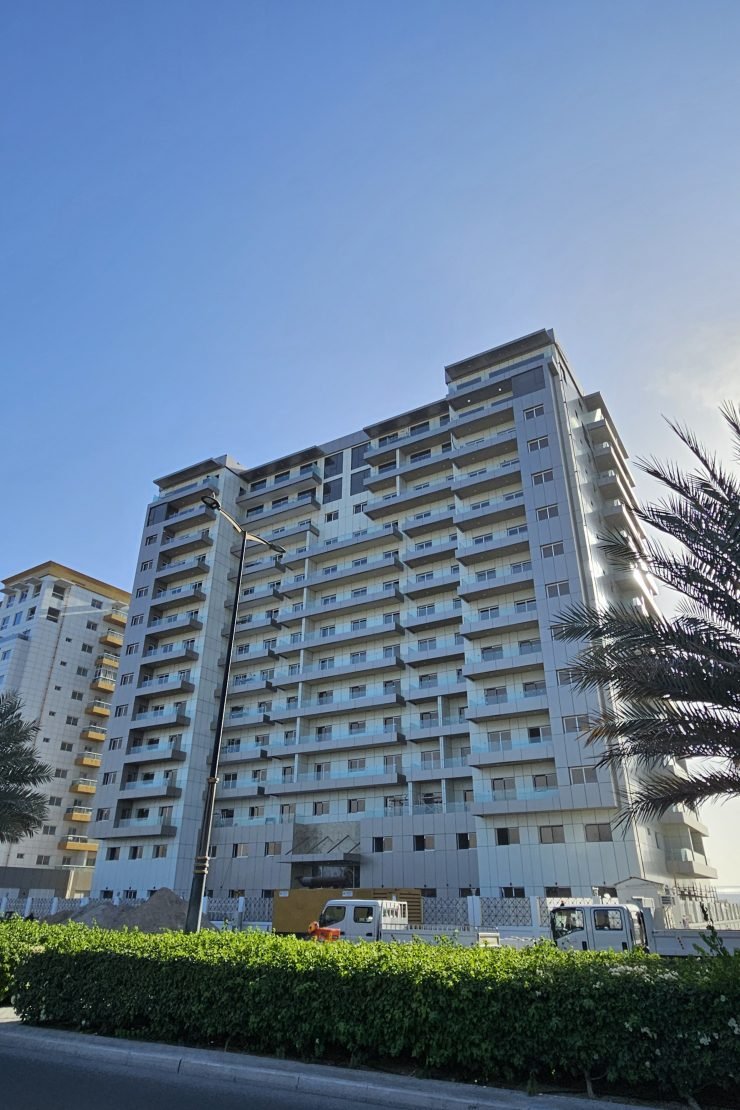
The handover team wrote to us six weeks after the first inspection to say every item on the list was closed. It was a two bedroom in a Business Bay tower, and the first visit had produced a long list, mostly door alignment, silicone and paint. On the return visit most of it genuinely was done. But the same balcony door still dragged on the threshold, and two repainted patches had gone on over damp plaster and were already blooming through. That is the entire reason the second visit exists.
In Dubai a paid snag re-inspection typically costs AED 500 to AED 900 for an apartment and AED 1,200 to AED 2,000 for a villa, roughly one third of the original inspection fee. Several Dubai firms include one re-inspection free, though almost none publish how long that free visit stays valid.
What a Snag Re-Inspection Actually Is
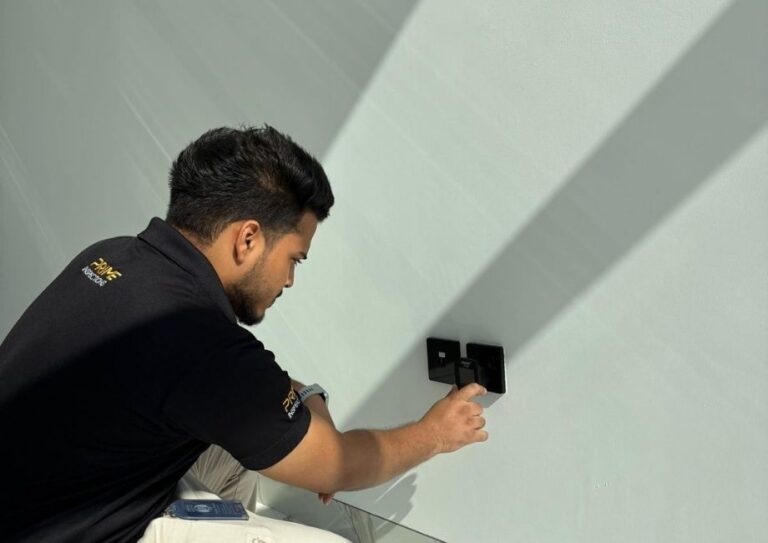
A re-inspection, also called a de-snag inspection or simply the second visit, checks whether the repairs on your snag list were actually completed. It is a de-snag verification visit, and it is deliberately narrow. Nobody is looking for new things to sell you.
Listed items only, or a full re-sweep
This is the first question to ask any firm, because it changes what you are buying.
A listed items check works down your original snag list, item by item, marking each one closed or still open. Faster, cheaper, and what most firms mean by a re-inspection.
A full re-sweep repeats the whole inspection. It catches damage caused during the rectification itself, which happens when three trades work in one apartment in a week. It costs more because it is closer to a second full inspection.
What the second report contains
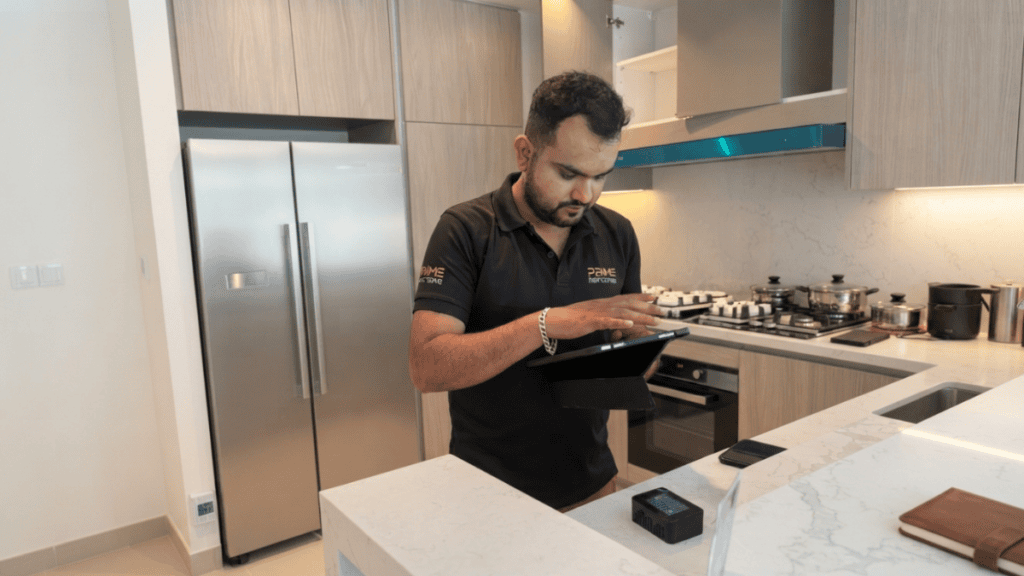
A useful de-snag report is not a fresh document that ignores the first one. It carries your original snag list reference numbers, a pass or fail against each, dated photographs of the failures, and anything new that appeared during the repair work. That structure lets you reply to the developer using their own numbering rather than starting a new argument.
What we do not do is chase the developer or manage the repair programme. We verify and document. What you do with that is your call.
Snag Re-Inspection Cost in Dubai, the Real Numbers
Across the Dubai firms that publish anything at all, a paid re-inspection sits in a fairly narrow band. The table below is indicative Dubai market pricing drawn from published sources as at September 2026, not any single firm’s rate card.
| Unit type | Typical paid re-inspection | Share of original fee |
| Studio | AED 500 to 600 | About one third |
| One bedroom | AED 500 to 700 | About one third |
| Two bedroom | AED 600 to 800 | About one third |
| Three bedroom | AED 700 to 900 | About one third |
| Townhouse | AED 900 to 1,400 | One third to one half |
| Villa | AED 1,200 to 2,000 | One third to one half |
Apartments
Oliva publishes the only per unit re-inspection column we found, running from AED 500 for a studio to AED 1,500 for a villa. Dubshy advertises desnagging from AED 499 without size bands. In one published industry comparison, PropertyCheck is listed at AED 1,050 against an AED 3,150 base fee on a 3,000 sqft property, which is 33 percent.
Villas and townhouses
The same comparison lists Land Sterling at a 30 percent discount and RAMI at 50 percent, both proportional rather than flat. Where a firm discounts by percentage instead of charging a flat fee, a villa owner pays more in dirhams for the same visit than an apartment owner does.
Why the villa gap is wider
Two reasons, and neither is that the property is expensive. A villa snag list is longer to start with, so the verification pass takes longer. And villa items sit further apart, in a plant room, on a roof, at a boundary wall and across two floors, so the inspector walks much further to check the same number of items.
On tax, VAT in the UAE is 5 percent on inspection services, so an AED 600 re-inspection is AED 630 on the invoice. Ask for the TRN on it, particularly if the property is an investment.
Free or Paid, and Which Dubai Firms Do Which
The Dubai market splits cleanly in two on this, and the split is not about quality.
Firms that include one visit
Handover Heroes states a complimentary de-snagging follow up as standard. Zia Property Snagging, at snagginginspection.ae, advertises a free re-inspection with every package. Metropolitan Premium Properties includes unlimited re-inspection, but only in its upper tier Full Assistance Package, with the Basic package carrying one visit.
Firms that charge
Oliva, Dubshy, PropertyCheck, Land Sterling and RAMI all price it, as a fee or as a discount off the original. Expert Property Snagging publishes a full rate card across four emirates and still carries no de-snag price at all, which tells you how unstandardised this part of the market is.
Worth noting, Oliva’s page claims a free re-inspection in one place and prints paid per unit prices in another. Pages get updated at different times, so confirm the policy in writing rather than reading it off a webpage.
The read across all of it is simple. Free almost always means one visit. If your developer needs two rounds of repairs, and on a long list that is common, the second round is usually chargeable wherever you booked.
Why the Fee Lands at About One Third
Two independent sources land on the same ratio, which is unusual in this market. PropertyCheck’s AED 1,050 against a AED 3,150 base is 33 percent, and Land Sterling’s 30 percent discount arrives at almost the same place from the opposite direction.
That is not a standard and it is not regulated. It is just what the arithmetic of the work produces.
The first inspection is mostly discovery. Every room, every system, every surface, with nothing known in advance. The second visit skips discovery entirely, because the list already exists. What remains is travel, access coordination, verification of a defined set of items and a shorter report. Roughly a third of the work, roughly a third of the fee.
Where a de-snag costs more than a third, it is usually a full re-sweep rather than a listed items check, which is a fair reason to charge more.

Does the Free Re-Inspection Expire
Here is the part of the offer that almost nobody in Dubai puts in writing.
We looked for a published time limit on free re-inspections and did not find one. No validity window, no deadline, no stated number of months. That gap matters, because Oliva puts typical rectification at two to six weeks and Dubshy advises booking the de-snag within a few weeks of the completion notice, while in cluster handovers, where one contractor works through dozens of units, repairs routinely slip to three or four months. If a free visit quietly expired at ninety days and nobody told you, you find out at exactly the wrong moment.
So before you accept a free re-inspection as part of a package, ask three things and get the answers in writing:
How many re-inspection visits are included, and is it one or unlimited?
Until when is the included visit valid, counted from what date?
Is the included visit a listed items check or a full re-sweep?
Ask us what our de-snag window is when you book, and we will put it in the confirmation rather than leave you to guess.
What Happens If Defects Are Still There
If items are still open, nothing dramatic happens, and that is the point.
A fresh follow up list is issued and the cycle repeats. Dubshy frames this correctly as the owner’s right under the defects liability period, not a favour. You send the updated list back with the failed item numbers and dated photographs, and the developer schedules another round.
That is what happened with those two blooming patches in Business Bay. They did not become a dispute. They went onto a fresh list with photographs attached, and the plaster was dried and redone properly the second time, which is all anyone actually wanted.
Partial rectification
One rule worth knowing before you pick a firm on price. If 40 of your 60 items are closed and 20 are not, using your included free visit to discover that consumes the visit, and round three is chargeable at most firms. That is why the count and the validity window matter more than the headline fee.
Escalation through RERA and DLD
If a developer will not engage at all, Oliva points to the right routes, a RERA complaint or Dubai Land Department dispute resolution. Before it gets there, remember what your leverage actually is. It is your handover acceptance signature, not your money. Do not withhold the final instalment as pressure, because that engages Article 11 of Law No. 13 of 2008, and above 80 percent completion a developer can retain a substantial share of what you have paid or move to a DLD auction.
The Defects Liability Period Clock
The clock that actually matters is not the developer’s repair schedule.
Under Dubai Law No. 6 of 2019, Article 40, structural liability runs for ten years from the building completion certificate, and mechanical, electrical and plumbing liability runs for one year from unit handover. Commentary differs on exactly when that one year period starts, so the safe approach is to assume the earlier of the possible dates and work to that. Federal Decree-Law No. 25 of 2025 renumbers the decennial liability provisions from 1 June 2026, which is a renumbering and not a change to what you are owed.
De-snag versus the eleven month pre expiry inspection
Every competing page treats these as one product. They are not.
A de-snag visit verifies repairs against a list you already hold. It happens weeks after handover and it is narrow by design.
An eleven month inspection is a fresh full sweep booked before the one year MEP period closes, looking for what has emerged since you moved in. A Dubai summer is a real stress test, and things surface in month nine that were invisible in month one. Different timing, different scope, different fee.
A Worked Example on a Business Bay Two Bedroom
Put real numbers on the Business Bay apartment and the decision gets easy.
The first inspection produced 47 items. Our two bedroom handover snagging starts from AED 1,499 excluding VAT. The developer took five weeks and reported everything closed.
The market rate for a re-inspection on a two bedroom is AED 600 to 800, so call it a third of the original fee. On the return visit, six items were still failing, including the balcony door threshold and the two paint patches over damp plaster.
Six unresolved defects against a fee in the AED 600 to 800 band. If one of those six had been a chilled water leak behind a bathroom wall rather than a paint patch, the arithmetic would not have been close at all.
How Prime Handles the De-Snag Visit
At Prime the second visit is booked on its own and the fee is confirmed when you book. We do not fold it into a package price you may never use, and we do not publish a fixed rate, because the right fee depends on the length of your list and whether you want a listed items check or a full re-sweep.
The report comes back within 24 hours, structured against your original snag list numbers with a pass or fail on each and dated photographs of anything still failing. Our handover snagging runs to 250 plus checkpoints, our inspectors are InterNACHI certified, we are RERA certified and DED registered, we have completed 73,000 or more inspections and we hold a 4.9 Google rating from 108 or more reviews.
The part that matters most on a de-snag is the simplest. We did not carry out the repairs, we are not connected to whoever did, and we gain nothing from the answer either way. Prime sells the answer, never the work.
Book a de-snag verification visit. Call +971 50 602 1830 or email connect@primeinspections.ae.
Frequently Asked Questions
How much does a re-inspection cost after snagging in Dubai? Where it is charged, expect AED 500 to 900 for an apartment and AED 1,200 to 2,000 for a villa, roughly a third of the original inspection fee. Several Dubai firms include one visit free instead.
Is the second snagging inspection free? It depends on the firm. Handover Heroes and Zia advertise a free follow up, while Oliva, Dubshy, PropertyCheck, Land Sterling and RAMI charge or discount. Free almost always means one visit, and no firm publishes an expiry date.
What is de-snagging? De-snagging is the verification visit after the developer repairs the items on your snag list. The inspector works through the original list and records each item as closed or still open, with photographs of the failures.
Do I need a second snagging inspection? If you want proof rather than an email, yes. Once you sign off on the rectification you lose most of your practical leverage, and a self checked list carries very little weight if the item comes back later.
How long does the developer have to fix snags? Oliva puts typical rectification at two to six weeks, though cluster handovers often run longer. The binding clock is the defects liability period, not the repair schedule, so track the one year MEP window rather than the promises.
Can I use the report as evidence? A dated, photographed report from a certified inspector is the strongest documentation a private owner can realistically produce, and it is accepted as documentary evidence. It is not binding on a developer by itself, but it changes the conversation considerably.