AC Not Cooling at Handover in Dubai: How to Diagnose It Before You Sign
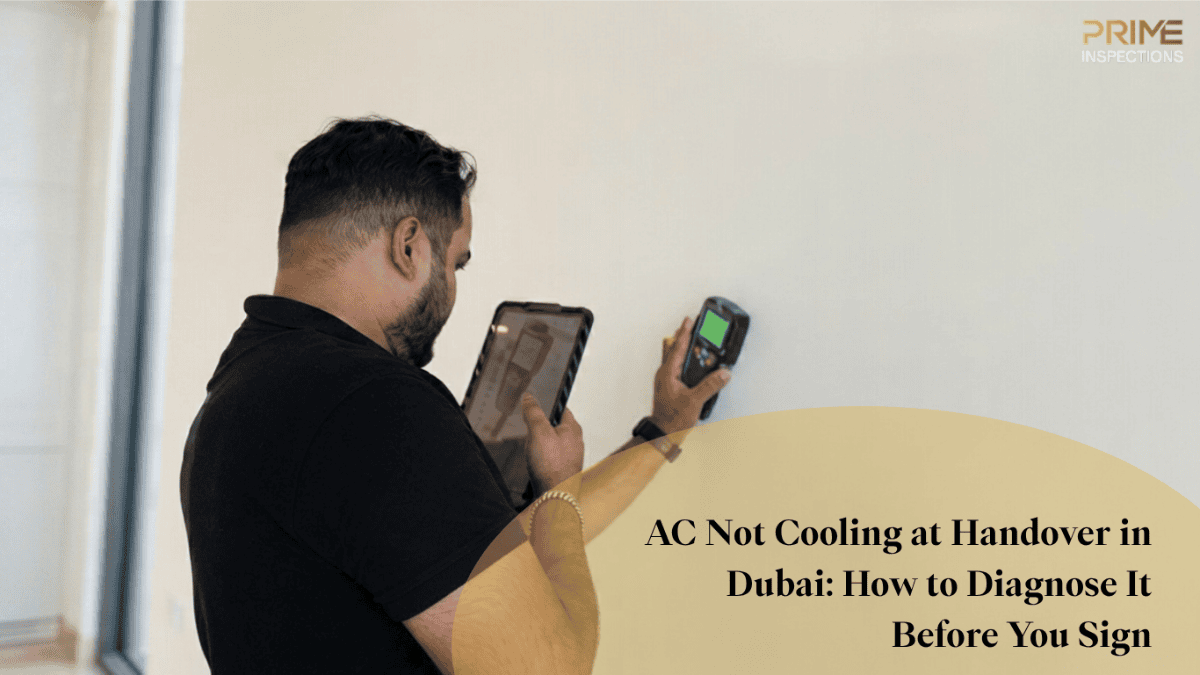
Last August we were standing in a Business Bay tower at about half past two in the afternoon. Outside, the ambient was sitting in the mid forties. Inside, the owner had walked every room and pushed every thermostat down to 16. The ceiling diffusers were moving air. The air was warm.
The developer representative said what we hear on most summer handovers. “Give it time to settle. It is normal in this heat.”
The owner looked at us. He had waited three years for these keys and he had a handover acceptance form in front of him.
Here is what we told him, and it is the same thing we will tell you.
The short answer
If your AC is not cooling at handover in Dubai, do three things before you sign. First, identify which cooling system the unit uses. Second, confirm the cooling account is active. Third, measure supply air against return air. Only then decide whether it is a defect.
That order matters. Most owners jump straight to blaming the equipment, and in the majority of the handovers we attend the real cause is further back in the chain. An unregistered district cooling account looks exactly like a broken fan coil to anyone standing in the room without an instrument. The difference is who pays and how fast it gets solved.
A Dubai Creek Harbour case that repeats every season
A two bedroom apartment, brand new, fan coil running smoothly, airflow strong at every grille, and not one degree of cooling anywhere in the unit. This is a pattern we see often on inspections in Dubai Creek Harbour. The owner was already drafting a complaint about faulty equipment. We opened the ceiling access panel, checked the energy meter, and found the chilled water account had never been registered. DEWA was live. Lights, sockets, water heater, all fine. The cooling supply was simply not switched on at the provider end.
The lesson is blunt. No district cooling account means no cooling, no matter how healthy your DEWA connection is.
The three cooling systems in Dubai homes and why the difference matters
You cannot diagnose a warm room until you know what is supposed to be making it cold. Dubai homes run on three broadly different arrangements, and each one fails in its own way.
Split or ducted DX with an owner side condenser
Common in villas, townhouses and older low rise buildings, including many of the properties we inspect in Emirates Hills and Tilal Al Ghaf. There is a condenser outside, usually on a roof, a side yard or a service balcony, connected by refrigerant lines to an indoor unit or a ducted air handler.
What running looks like: the outdoor fan spins, the compressor makes a steady hum, and the indoor unit blows noticeably cold air within a couple of minutes.
What failure looks like: the indoor fan runs but the condenser never starts, or it starts and cuts out within a minute. Warm air at the grille with a silent condenser is an equipment or control fault, and on a new villa it belongs to the developer.
Chilled water fan coil unit on district cooling
This is the standard for most apartment towers and many master community villas served by Empower, Emicool or Tabreed, including waterfront towers like those on Bluewaters Island and Palm Jumeirah. There is no compressor inside your home at all. Chilled water is produced at a central plant, piped to your building, and passed through a coil inside your fan coil unit while a fan blows room air across it.
That single fact changes everything about diagnosis. Your fan coil can be perfectly healthy, spinning at full speed, and still deliver warm air, because the fan is not the thing that makes cold. The chilled water is. When people tell us “the AC is running”, they are describing the fan. It tells you almost nothing.
What failure looks like: strong airflow, room temperature air, no condensation on the coil, no water in the condensate tray, and a thermostat that never satisfies.
Central building chiller served risers
Some developments, such as parts of District One, run their own chiller plant on the roof or in a basement rather than buying from a district provider. From your side it behaves like district cooling, but the responsible party is the building owner or the owners association, not an external utility.
What failure looks like: identical symptoms to the district cooling case, except the fix sits with facilities management. On handover day, that still routes back to the developer through our complete building inspection process.
We put this section first for a reason. A snag written as “AC not working” gets a shrug. A snag written as “fan coil FCU-3 delivering supply air within 2 C of return air, chilled water not reaching coil” gets an engineer sent up.
District cooling versus DEWA: the number one cause of a warm handover day
District cooling is not part of your DEWA account. It is a separate utility, with a separate provider, a separate registration, a separate deposit and a separate bill. Two accounts, two activations, two things that can be missed.
Owners get caught out because DEWA activation feels like the finish line. You pay, the power comes on, the lights work, the taps run. It is reasonable to assume cooling comes with it. In an apartment on district cooling, it does not.
A district cooling bill usually has two parts:
Capacity charge. A fixed monthly charge based on the cooling capacity reserved for your unit, expressed in refrigeration tonnes (TR) or refrigeration tonne hours (RTh). You pay this whether you are living there or not.
Consumption charge. What you actually use, metered by an energy meter that sits in a service cupboard or riser near your unit.
There is normally a refundable deposit at registration as well, and the provider will want the title deed or SPA, Emirates ID or passport, and the unit reference before they open the account.
For DEWA itself, activation deposits are commonly quoted around AED 2,000 for an apartment and AED 4,000 for a villa. Treat those as reference figures and verify current amounts on dewa.gov.ae, since utility charges change without much notice.
The practical takeaway on handover day is a two minute check. Ask the handover team for the district cooling provider name and the unit meter reference. Then ask a question that cuts through everything: is the chilled water supply to this unit energised today, yes or no. If nobody in the room can answer that, you have not been handed a working home. You have been handed a room with a fan in the ceiling.
Not sure whether it is the account or the equipment? Speak to our engineer on +971 50 602 1830 or WhatsApp for an instant quote.
How an engineer diagnoses it in the first fifteen minutes
We work only for homeowners, never for developers or real estate agents. That independence matters most in this exact moment, when somebody with a clipboard is telling you a warm apartment is normal for summer. Our job is to establish whether that is true for your unit, on today’s numbers. You can read more about how our team works on our about us page.
Here is the order we work in.
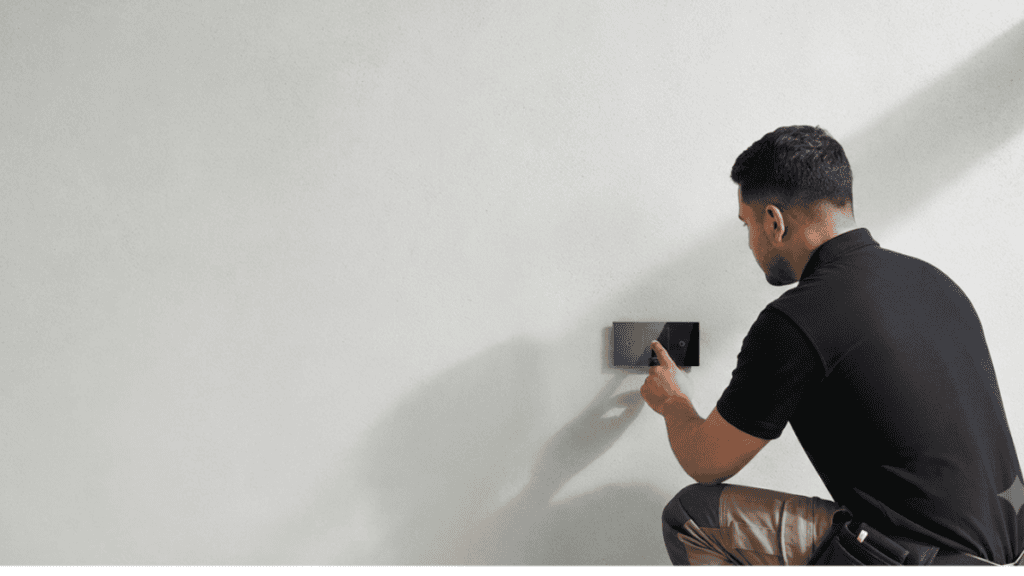
Is the thermostat commissioned and addressed to the right unit
More often than people expect, the thermostat on the wall is not talking to the fan coil above the ceiling in that room. In new towers, thermostats get addressed during commissioning, and addressing errors survive to handover. The tell is a set point that changes nothing, or a bedroom that responds when you adjust the living room. This is one of the checks built into our new handover snagging inspection.
Is the chilled water isolation valve open
Every fan coil has isolation valves on the chilled water flow and return, usually above the nearest ceiling access panel. Contractors close them during fit out to protect the coil and to stop condensation staining fresh paint. Sometimes they never get reopened.
We had an apartment where the master bedroom cooled beautifully and the other three rooms stayed warm. The owner was convinced the building had a plant problem. One access panel later, we found a closed isolation valve feeding the affected branch. The whole thing was a ten minute fix once it was identified in writing.
Room by room variation almost always points to distribution, not to capacity. If the building plant were failing, your master bedroom would be warm too.
Are the filters blocked with construction dust
New units are not clean units. Fit out generates gypsum dust, cement dust and sawdust, and if the AC ran during finishing works, that all went through the filter. A loaded filter starves the coil of airflow, and the room never catches up. We cover this in detail further down in our Dubai Hills Estate case below.
Was air balancing ever carried out
Air balancing is the commissioning step where a technician sets dampers and grille flows so each room gets its designed share of air. Skipped or rushed, you get one freezing room and two warm ones from a system that is technically working. We check for balancing evidence and measure grille velocity rather than taking the word for it.
Is the condensate drain running
A coil that is genuinely cooling pulls moisture out of the air, and that water has to go somewhere. A bone dry condensate tray on a 45 degree day is a strong signal that no real cooling is happening. A blocked or backing up drain is a different problem, and it is one that turns into a ceiling stain within weeks — something our water leakage inspection team sees constantly.
“The exact source of the problem was identified.” That line, from a client review, is the whole point of this stage. Anyone can say the AC is weak. The value is in naming the component.
Delta T and the supply versus return measurement
This is where an inspection stops being an opinion.
Return air temperature is the temperature of the air being drawn back into the unit through the return grille. It is essentially your room temperature.
Supply air temperature is the temperature of the air coming out of the diffusers.
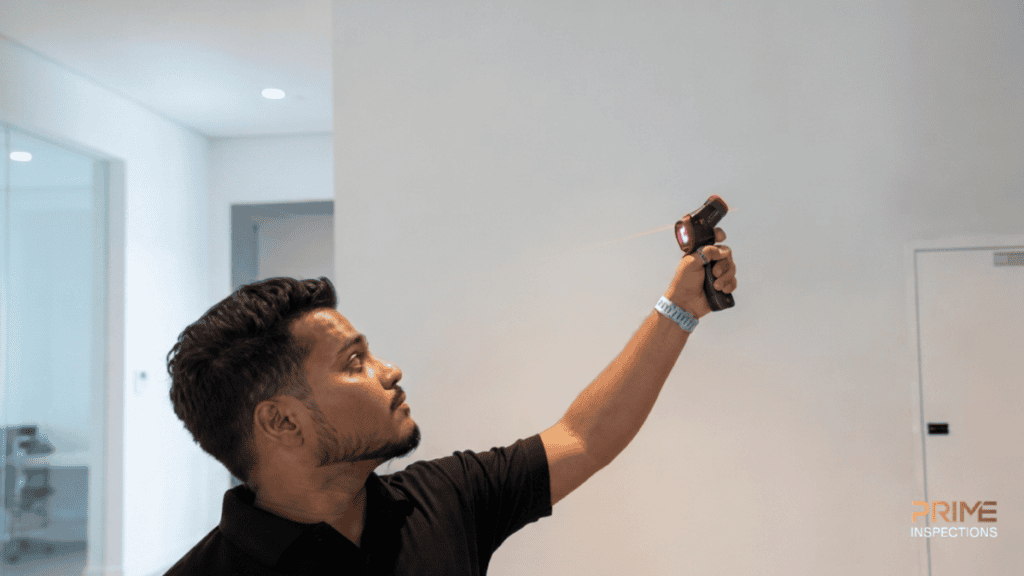
The difference between them is the air side delta T, and it tells you whether the coil is doing work. On a healthy system in normal operation, engineering practice looks for a meaningful split, commonly in the region of 8 to 12 C between return and supply when the system has settled. A split of 2 or 3 C means the coil is barely cooling, whatever the fan is doing.
There is a second delta T that matters on chilled water systems: the temperature difference between the chilled water entering the coil and the water leaving it. If flow and return water are almost the same temperature, water is passing through without picking up heat, which usually points to airflow, a fouled coil or a valve issue rather than the plant.
Two honest caveats. First, no developer or authority in Dubai publishes an official acceptance temperature that you can quote back like a regulation. These are engineering practice benchmarks used to judge performance, not legal thresholds. Second, they are read after the system has run long enough to stabilise, not thirty seconds after somebody switches it on.
We record all of this with calibrated instruments and thermal imaging as part of our complete building inspection and handover snagging scopes, and our inspections are carried out by InterNACHI certified, RERA certified inspectors, which is what makes the numbers hold up when a developer’s contractor disputes them.
A Dubai Hills Estate villa that looked like a design failure
Split systems throughout, owner convinced the units were undersized for the glazing. This is one of our more instructive Dubai Hills Estate inspections. We measured supply air only a few degrees below return on every indoor unit. Then we pulled the filters. Every one of them was grey with construction dust, packed solid enough to hold its own shape.
Filters replaced, system given time to settle, delta T came back into range across the house.
A small delta T with a dirty filter is a commissioning failure, not a design failure. Those two conclusions have very different price tags, and only one of them is the developer’s to fix.
We log supply and return temperatures, thermal images and a full temperature map into a photo based digital report within 24 hours. Book your handover inspection before you book your free sample report call.
The 45 degree reality: what “cooling properly” actually means in a Dubai August
Let us be fair to the equipment for a moment, because this is where owners sometimes ask for the impossible.
Dubai ambient regularly exceeds 45 C in July and August, and rooftop surfaces and glazed facades sit hotter still. Residential cooling systems are sized to hold an indoor design condition against a design outdoor condition, not to deliver arctic air on demand. At peak afternoon load, a healthy system may only pull the space to roughly 10 to 12 C below ambient.
Run the numbers on that. At 45 C outside, a living room sitting at 24 C at three in the afternoon is a system doing its job. The same room at 39 C is not.
Two things move that goalposts legitimately:
Glazing load. Floor to ceiling glass is a heat collector. A west facing living room takes direct solar gain through the hottest part of the afternoon, and it will always lag a north facing bedroom.
Solar heat gain on the envelope. Top floor units, corner units and rooms above unconditioned space carry extra load that the same equipment has to overcome — a factor we weigh heavily during a resale property inspection on an older tower.
So when a handover team says “it is the heat”, they are sometimes right. Our position is not that they are lying. It is that nobody in the room knows until somebody measures. A warm handover day is not automatically a defect. An unmeasured handover day is always a risk.
Normal versus defect: a tolerance table
| Symptom | Likely cause | Verdict | Who pays |
|---|---|---|---|
| Air blowing, zero cooling, whole unit | District cooling account not activated | Not a defect | Owner registers, no repair cost |
| Air blowing, zero cooling, account confirmed active | Chilled water not reaching coil, valve or plant issue | Defect | Developer |
| One room warm, others cold | Closed isolation valve or air balancing not done | Defect | Developer |
| Delta T of 2 to 4 C with visibly dirty filters | Commissioning and cleaning not completed | Defect | Developer |
| Room at 24 C at 3pm, ambient 45 C, delta T in range | System performing to design | Not a defect | Nobody |
| Thermostat set point does nothing | Thermostat not commissioned or wrongly addressed | Defect | Developer |
| Condenser never starts on a split system | Electrical, control or equipment fault | Defect | Developer |
| Water staining near the fan coil | Condensate drain blocked or poorly installed | Defect | Developer |
What to do step by step on handover day
- Switch every AC on at the start of your walkthrough, not the end. Give the system at least twenty to thirty minutes to settle before you judge it.
- Ask which cooling system serves the unit, and get the provider name if it is district cooling.
- Confirm in front of the handover team whether the chilled water supply or cooling account is energised today.
- Check every thermostat responds and controls the room it is mounted in.
- Open the ceiling access panels and photograph the fan coil, the isolation valves and the condensate connection.
- Pull and photograph the filters. Construction dust is evidence.
- Measure return air at the grille and supply air at the diffuser in every room, and write both numbers down.
- Photograph the thermostat display showing set point against actual room temperature, with a timestamp.
- Get every finding written into the snag list with room references, unit tags and measured values, not adjectives.
- Do not sign the handover acceptance form until the AC has been measured and the finding is recorded in that snag list.
That last step is the one that decides how the next six months go.
Getting it fixed: escalation when the developer says it is normal
Most AC snags get resolved quietly once they are documented properly. When they do not, escalate in this order.
Written, dated notice. Email the developer’s handover or customer care team with the measured values, photographs and unit references, citing the defect clause in your SPA and the Defects Liability Period. Verbal complaints on handover day are worth nothing three weeks later.
Customer care, then head of customer experience. In writing, referencing your original notice date. Keep the thread in one chain so the timeline is self evident.
RERA or the Dubai Land Department. Complaints can be filed via the Dubai REST app or the Dubai Land Department website. The fee is commonly cited at AED 1,000 per complaint with a decision target around 60 days. Verify the current fee before filing, and treat the 60 days as a target rather than a guarantee.
Dubai Courts. The final route, and rarely necessary for a cooling defect. Details on filing a civil claim are available on the Dubai Courts website.
One correction worth making, because we hear it constantly: the Rental Disputes Centre does not hear buyer versus developer defect disputes. It handles landlord and tenant matters. Filing there wastes weeks.
On the legal side, be precise about what covers what. Decennial liability, now under Article 821 of Federal Decree-Law No. 25 of 2025 (previously Article 880 of Federal Law No. 5 of 1985), covers structural stability and safety of the building for ten years, and Article 823 voids any contract clause that tries to limit or exclude it. Comfort cooling is not structural. The MEP warranty you were offered, commonly twelve months, is a contractual term in your SPA, not a statutory requirement. That is why your real instrument here is the contract and the DLP, not the decennial provision.
Which brings us to a client we could not help as much as we wanted to. He had signed on handover day, taken the keys, and only escalated the AC two months later when the summer really arrived. This is exactly the pattern we describe in what to do when a developer ignores your snag list. The defect was real and it was eventually accepted, but he spent weeks proving it existed at handover rather than pointing at a document that already said so.
Measure before you sign. The signature is what fixes your position.
What it costs
Snagging inspection fees in Dubai are quoted by unit size and complexity. As a broad market range, expect roughly AED 700 to AED 1,500 for a one bedroom apartment, AED 1,200 to AED 2,500 for larger apartments, and AED 2,500 upward for villas and townhouses depending on built up area and whether a desnag revisit is included. Treat those as market ranges only and request a quote for your specific unit.
On timing, developer rectification of MEP snags commonly runs around four to five weeks in this market from written notice to completed fix. That is our field observation across handovers, not a legal deadline, and your SPA may say something different.
Your snagging window is also SPA dependent. Many contracts allow seven to fourteen days from handover notice to complete inspection and submit snags. Check your own agreement rather than assuming, and if you’re renovating rather than accepting a first handover, our contractor work inspection service covers the same measurement standard.
If you are overseas
Plenty of our clients never set foot in the unit on handover day, and that is workable if you set it up properly.
Issue a power of attorney or a simple authorisation letter naming your representative so they can attend the handover and receive keys on your behalf. Ask for a live video walkthrough during the inspection so you see the measurements being taken rather than reading about them afterwards. Take the digital report, read it fully, and question anything unclear before you respond to the developer.
The one rule we will not soften: never authorise signing of the handover acceptance form remotely before you have read the inspection report. Once that form is signed, you have accepted the unit in its current condition, and everything after that is a negotiation instead of a right.
Frequently asked questions
Why is my new AC blowing air but not cooling? Because the fan and the cooling source are separate. In an apartment on district cooling, the fan coil blows air across a coil fed by chilled water. If that water is not arriving, whether from an inactive account, a closed valve or a plant fault, you get full airflow and zero cooling.
Is district cooling the same as DEWA? No. DEWA supplies electricity and water. District cooling is supplied by a separate provider such as Empower, Emicool or Tabreed, with its own registration, deposit and bill. Having an active DEWA account does not give you cooling in a district cooled building.
Do I need a separate district cooling account for a new apartment? Yes, if your building is served by a district cooling provider. You register separately, pay a refundable deposit, and then receive a monthly bill made up of a fixed capacity charge and a metered consumption charge. Without registration, no cooling reaches your unit.
What temperature should AC supply air be in Dubai? There is no published legal figure. As engineering practice, we look for supply air roughly 8 to 12 C below return air once the system has stabilised. Absolute supply temperature varies with room conditions, so the difference between supply and return is the more reliable indicator.
What is delta T and why does an inspector measure it? Delta T is the temperature difference across a component, most often between return air and supply air, or between chilled water flow and return. It converts a subjective complaint into a number. A small delta T proves the coil is not transferring heat, which is what makes a snag defensible.
Can I refuse to sign handover because the AC is not cooling? You can decline to sign an acceptance form while a material defect is unresolved, though the practical route is usually to sign with the defect formally recorded on the snag list. Check the exact wording of your SPA, because acceptance terms and remedies vary between developers.
How long do developers take to fix AC snags? In our experience across Dubai handovers, MEP rectification commonly takes around four to five weeks from written notice. That is a market observation and not a legal deadline. Documented, dated notices with measured values consistently move faster than general complaints.
Is it normal for AC to struggle at 45 degrees in Dubai? Partly. At peak ambient, a healthy residential system may only hold roughly 10 to 12 C below outdoor temperature, so 24 C indoors on a 45 C afternoon can be normal performance. A room sitting close to ambient, or a delta T of only a few degrees, is not.
Who pays for AC repairs after handover? Within the Defects Liability Period, genuine defects are the developer’s cost. Consumables, filter cleaning after you move in, and damage from misuse fall to the owner. The cleaner your handover documentation, the easier that line is to hold.
Does the Defects Liability Period cover air conditioning? Usually yes, as part of the MEP scope, but the length and wording come from your SPA rather than from statute. Decennial liability under Article 821 covers structural stability, not comfort cooling, so your AC claim rests on the contract.
Can you inspect AC if DEWA is not connected? Not meaningfully. Without power, and without the cooling supply energised, we can inspect installation quality, ductwork, access and condensate routing, but we cannot measure performance. We usually recommend rescheduling the performance element rather than issuing an incomplete verdict.
What is a chilled water fan coil unit? It is an indoor unit containing a coil and a fan, with no compressor of its own. Chilled water produced at a central plant flows through the coil, the fan blows room air across it, and heat transfers into the water. It is the standard arrangement in Dubai apartment towers.
Book an inspection
If your handover is this week, get the AC measured before the acceptance form is in front of you. Our engineer led snagging inspection covers 250 plus points across walls, MEP, plumbing, electrical and HVAC, with thermal imaging, a full temperature map and a developer ready rectification checklist delivered as a photo based digital report within 24 hours.
We work only for homeowners, never for developers or real estate agents, and we cover Dubai and the wider UAE. Browse our full blog for more community specific handover guides.
Book your handover inspection on +971 50 602 1830 or WhatsApp for an instant quote.