How to Hold a Fit-Out Contractor to a Snag-Free Standard
It was 10:40 on a Tuesday morning in March, on the 27th floor of a tower in Business Bay. The owner had just finished a full fit-out of her two bedroom apartment.
New kitchen. Two bathrooms rebuilt. Engineered wood flooring, and a gypsum ceiling with linear lights. She had booked fit-out snagging with us because the contractor’s final invoice was already sitting in her inbox.
Malik had barely set his bag down when she asked the question we hear most weeks. “It all looks finished. Is it actually finished?”
To hold a fit-out contractor to a snag-free standard, write the finish schedule and acceptance tolerances into the contract, tie each payment to an inspected stage, and keep a final payment or retention until every snag is closed. Then work from one independent snag list, with photos, locations and readings, that both sides sign.
A contractor’s “done” and an owner’s “done” are rarely the same thing. The contractor sees a room that is painted, tiled and lit. The owner will live with what sits behind the tiles for the next ten years.
In this guide to fit-out snagging we cover what to write into the contract, when to inspect, how to close the list, and what to do if the contractor stops answering.
What Does Snag-Free Actually Mean in Fit-Out Snagging?
Most disagreements at the end of a fit-out start with one word that nobody defined. “Finished” means one thing on the contractor’s side and another on yours.
Good fit-out snagging starts by separating the problems into types. That way each one is handled the right way.

Snags, Defects and Unfinished Work Are Not the Same Thing
We sort every item into one of three groups.
- Snags are visible finishing faults. Paint runs, gaps in silicone, a cabinet door that sits out of line.
- Defects are performance problems. A leak, a shower floor that falls the wrong way, a socket with no earth, or hollow tiles in a wet area.
- Incomplete work is scope that was agreed and never done. A missing access panel, a skirting run that stops halfway.
They need different fixes and timelines. In our fit-out snagging reports they sit in separate columns, so nobody argues about paint while a leak waits.
Why “To Industry Standard” Protects the Contractor, Not You
Many home fit-out contracts say the work will be completed “to industry standard”. It sounds reassuring.
In a dispute, though, the contractor’s idea of normal usually wins. Fit-out snagging needs something written down to measure against.
What helps is a written reference. A finish schedule, a product list, drawings, and agreed tolerances.
Snag-free does not mean perfect. It means matching what was agreed, within limits that were written down before work began.
What Should Be Written Into the Contract Before Work Starts?
The best fit-out snagging happens on paper, weeks before anyone picks up a tile. If the standard is clear at signing, the final inspection becomes a check, not an argument.
A Finish Schedule and Product List
Go room by room. Material, brand and model, colour code, grout colour, ceiling height, light positions, socket positions.
Add one line that says variations need written approval from you before they happen. A verbal “we used a similar one” is how most surprises start.
Acceptance Criteria You Can Actually Check
This is where fit-out snagging becomes measurable. A few criteria we see work well:
- Floor level variation stays within an agreed limit over an agreed length.
- Wet area floors fall to the drain, with no standing water after a test.
- No hollow tiles in wet areas.
- Every socket passes a function and earth test.
- No moisture readings above the dry reference after a flood test.
We are not going to give you millimetre figures here. Agree the numbers with your contractor or consultant, and write them in. The point is that they exist before the work does.
Payments Tied to Inspected Stages
A simple structure looks like this. A deposit, then a payment when first fix is complete and inspected, another when tiling is complete, and a final one at close-out.
Each payment follows a passed fit-out snagging check, not a WhatsApp photo. For an investor upgrading a rental unit, it also keeps the timeline honest.
Retention or a Held Final Payment
Retention is not required by UAE law. It is a contract term, known as retainage in some markets.
In commercial construction, 10 percent is common, often released half at completion and half after the defects period, usually around a year. Many home fit-out contracts have no retention at all.
So it has to be negotiated before you sign. Holding back money the contract says is due is a different thing, and it can put you in breach.
Which Approvals and NOCs Should Be in Place First?
A clean finish means little if the work was never approved. It is worth asking about approvals before the first wall comes down.
Building Management, Master Developer and Authority Approvals
The usual order starts with the building management or Owners Association. They issue the first No Objection Certificate, the NOC.
In Business Bay towers this often comes with set works hours, a service lift booking and a refundable works deposit. Where the community requires it, the master developer gives its own NOC.
Then comes the authority permit, if your scope needs one. Dubai Municipality covers most mainland areas. Trakhees covers areas such as Palm Jumeirah and Jebel Ali. The Dubai Development Authority covers its own free zone communities.
Dubai Civil Defence comes in when fire elements move, such as sprinklers, detectors or fire doors.
Ask your building management which approvals your scope needs. We can tell you which records to request from the contractor. We do not issue permits.
Why Unpermitted Work Becomes Your Problem Later
Unpermitted work can lead to fines or removal orders, and it can complicate a later resale or Dubai Land Department transfer. By then the contractor has moved on. The owner has not.
When Should the Work Be Inspected During a Fit-Out?
Every stage of a fit-out covers the one before it. So the cheapest time to find a fault is just before it disappears.
The Hold Points That Matter Most
These are the fit-out snagging stages where we suggest pausing for a check.
| Stage | What gets hidden next | What we check | Why it matters |
| First fix MEP | Walls and boards | Pipe routes, pressure test record, cable sizes, back boxes, AC duct and drain routes | Reopening walls later is slow and messy |
| Waterproofing | Screed and tiles | Membrane coverage, upstands, flood test with moisture readings | Leaks under tiles mean lifting tiles |
| Pre-tiling | Tiles | Substrate level, falls, pipe positions | Wrong falls are almost impossible to fix later |
| Before ceiling closes | Gypsum ceiling | FCU access, chilled water pipe insulation, fire stopping, sprinkler and detector positions | Missing access means cutting the ceiling |
| Final | Nothing | Finishes, function tests, thermal imaging scan, moisture meter readings, earth continuity | This is the list that decides the final payment |
| Re-inspection | Nothing | Every item on the list, closed or still open | “Closed” should mean seen, not reported |
If you can only afford one early visit, the pre-tiling stage catches the faults that cost most to reopen. Walls still open? Our independent fit-out inspection includes a pre-tiling stage check from AED 899, excluding VAT.
Who Should Do the Checking
A contractor with its own QA process is a good sign. But the team that did the work cannot also be the final judge of it.
An independent fit-out snagging report carries weight because every item is numbered, located, photographed, dated and backed by readings. Across 73,000+ inspections, that format is what we have seen move files.
If you are an overseas owner, this matters even more. A contractor’s photo shows what the camera was pointed at. A report shows the whole room.
What Did This Look Like in a Real Business Bay Fit-Out?
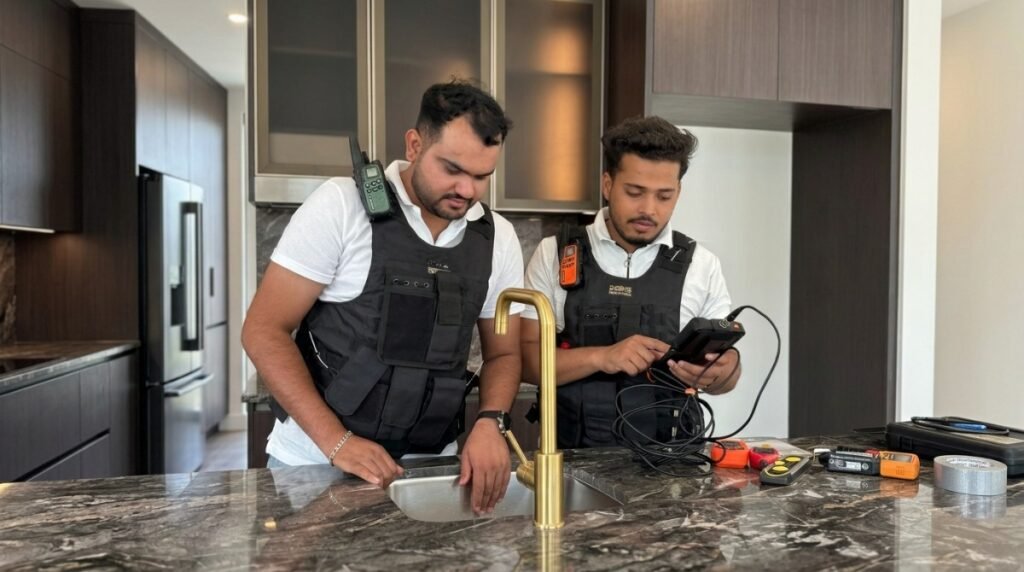
Back to the 27th floor. Malik spent a little under three hours in the apartment. On the surface, everything looked finished. Here is what the fit-out snagging found.
- Master shower floor. The slope ran towards the glass screen, not the drain, and three tiles sounded hollow on a tap test. It looked perfect until Malik ran water across it.
- Kitchen sink cabinet. The moisture meter showed raised readings under the sink. A compression fitting was weeping slowly, too slowly to see by eye.
- False ceiling. There was no access panel under the FCU. The next AC service would have meant cutting the new ceiling.
- Two sockets. Both worked, but neither had earth continuity. A lamp plugged in would never show the problem.
- Engineered floor. The expansion gap was missing along one wall, hidden under the skirting. It tends to show itself months later as lifting boards.
Mohammed Nadeem Maldar, our Engineering Manager, put it simply when we reviewed the report. “Most of what Malik found was invisible from the doorway. That is normal. A fit-out is built in layers, and every layer covers the one before it.”
Two things helped this owner. Her contract had a 10 percent final payment tied to completion. And the list was specific enough that nobody had to interpret it.
How Do You Run the Final Snag List and Close It Out Properly?
A snag list, sometimes called a punch list, only works if it closes. Most fit-out snagging fails at the closing, not the writing.
Build One Numbered List Both Sides Work From
This is the format we use, and it works for owners and property managers alike.
- Number every item.
- Note the room and the exact location.
- Add a photo with a reference point in frame.
- Label it as a snag, a defect or incomplete work.
- Record a reading where one applies, such as moisture or level.
- Agree a target date.
- Keep a status column.
One list, one version, one shared PDF. New items get new numbers at the bottom, never a fresh list.
Do Not Let the Contractor Close Its Own Items
“Closed” should mean someone checked it on a re-inspection. A WhatsApp photo of a fresh silicone bead is not the same thing.
We have written separately about what to do when a builder has marked snags closed but not fixed. It happens more often than people expect, and rarely on purpose.
A re-inspection is booked as a separate visit, so ask for the fee when you book.
The Handover Pack You Should Ask For
Before the final payment, ask for these.
- As-built drawings for concealed pipes and cables.
- Product warranties and manuals.
- A written waterproofing warranty.
- Pressure and flood test records.
- Approval and completion records from the building and any authority.
- The contractor’s own defects period, in writing.
Paperwork is far easier to collect while the last invoice is still open.
What Can You Do If the Contractor Will Not Fix the Snags?
Most contractors respond well to a specific list. Some do not. The steps below are general information, not legal advice.
Put It in Writing With a Deadline
Send a written notice by email, with the numbered list attached and a reasonable deadline. Keep WhatsApp for scheduling, not for the record.
If the contractor is asking to be paid first and fix later, we cover that situation in our guide on when a contractor demands final payment before fixes.
What the New UAE Civil Transactions Law Changed
The UAE Civil Transactions Law was replaced by Federal Decree-Law No. 25 of 2025. According to law firm commentary, Article 818(2) of the new law applies to contracts entered into on or after 1 June 2026.
Under it, an owner who has served notice and given a reasonable period to correct defective work may, after the facts are established, rescind or have another contractor do the work at the original contractor’s expense. Court permission is not needed first.
For contracts signed before 1 June 2026, the previous Civil Code applies. Under old Article 877, that step went through the court.
This is a right with conditions, not a shortcut. The facts have to be established, and the contractor can still challenge it. A dated, independent report is exactly the kind of record that helps establish them.
Structural Problems Have a Longer Clock
Decennial liability covers collapse and defects that threaten stability for 10 years. Commentary places it in Articles 821 to 824 of the new law.
Most fit-out snags are not structural, so do not assume this applies to yours. Speak to a lawyer for your specific contract.
Frequently Asked Questions
What does snag-free mean in a fit-out contract?
Snag-free means the finished work matches what was agreed in writing, within tolerances both sides accepted before work began. It does not mean flawless. Without a finish schedule, a product list and acceptance criteria in the contract, there is nothing to measure the work against once a disagreement starts.
How much retention should I keep from a fit-out contractor?
Retention is not required by UAE law. It is a contract term. In commercial construction 10 percent is common, often released half at completion and half after the defects period. Many home fit-out contracts have none, so agree a held final payment or retention before you sign anything.
When is the best time to inspect a fit-out?
Inspect just before each layer is covered: after first fix plumbing and electrics, after waterproofing with a flood test, before tiling, before the ceiling closes, and at the end. If you can only afford one early visit, the pre-tiling stage catches the faults that cost most to reopen.
Can I hold back the final payment until snags are fixed?
It depends on your contract. If the final payment is tied to snag close-out, holding it is simply following the contract. If it is not, withholding money that is due can put you in breach. Agree the link in writing before work starts, and speak to a lawyer for your specific contract.
Can I bring in another contractor to fix the defects?
For contracts signed on or after 1 June 2026, Article 818(2) of the new UAE Civil Transactions Law lets an owner, after written notice and a reasonable period, have another contractor correct the work at the original contractor’s cost without court permission. Older contracts follow the previous rules. Speak to a lawyer first.
Who issues fit-out approvals in Dubai?
Usually the building management or Owners Association gives the first NOC, sometimes with the master developer. The authority permit depends on the area: Dubai Municipality for most mainland communities, Trakhees in zones such as Palm Jumeirah, and the Dubai Development Authority in its own communities. Civil Defence joins when fire systems move.
Should waterproofing be tested before tiling?
Yes. A flood test on the membrane, left long enough to show a leak, with moisture readings below and around the area, is the cleanest way to prove a wet area before it is buried. Once the tiles go down, finding a waterproofing fault usually means lifting them again.
How much does a fit-out inspection cost in Dubai?
At Prime, a single bathroom or kitchen starts from AED 799, a full apartment from AED 1,699, a full villa from AED 4,299, and a pre-tiling stage check from AED 899, all excluding VAT. A re-inspection after fixes is booked as a separate visit, so ask for the fee when you book.
Closing the Job, Not Just Finishing It
The report for the Business Bay apartment went out within 24 to 48 hours. The owner sent the numbered list to her contractor, who was cooperative once the list was specific.
The work took about two weeks. When Farhan went back for the re-inspection, two items were still open: one tile and one socket. Both were closed on the second round.
Only then did she release the final payment. She paid the last invoice knowing what she was paying for.
If your fit-out is close to the final invoice, or the walls are still open before tiling, we are happy to take a look. Prime Inspections & Snagging inspects and reports. We sell the answer, never the repair work, so the list is only ever about what is there.
Fit-out snagging starts from AED 799 for a single kitchen or bathroom and from AED 1,699 for a full apartment, excluding VAT. Our clients have given us a 4.9 rating across 120+ Google reviews. If it helps, get in touch with our team and we will talk it through.