What to Do When You Find a Water Leak After Handover in Dubai

Water where it should not be is one of the few property problems that gets worse by the hour. If you have just found a leak in a new Dubai home, two things matter more than anything else in the next sixty minutes.
Contain it, and photograph everything before anyone touches it.
That second point saves people real money. The moment a contractor opens a ceiling to look, the evidence of where the water came from is gone.
And here is the part almost nobody tells you. The leak is almost certainly not coming from the spot where you can see it. Water travels. It surfaces at the weakest point, not the source. We are called out to more leaks than any other single problem, and in most of them the source is somewhere the owner never suspected. If you want an inspector on site today, our water leakage inspection is built for exactly this.
The First Thirty Minutes: What to Do Right Now
Before you think about who pays, deal with what is happening in front of you. Work through this in order.
1. Photograph everything, dated, before you move or touch anything. Wide shots and close shots. This is your record, and it decides who pays later.
2. If water is running and you can safely reach the supply valve, shut it off.
3. If a ceiling is sagging or bulging, keep out of that room and keep everyone else out. A saturated ceiling can come down without warning.
4. Contain and catch what you can. Move furniture, electronics and anything absorbent clear of the area.
5. Turn off the electricity to that part of the home if water is anywhere near a socket, a light fitting or the distribution board. Water and power in the same space is the one thing worth acting on straight away.
6. Notify your building management or Owners Association in writing today. Not a phone call. In writing, so there is a dated record.
7. Notify the developer in writing as well if you are still within your defects liability period.
8. Do not let anyone cut, open or repair anything until it has been photographed and the source has been found. Repairs destroy the evidence, and the evidence is what decides who pays.
Who Is Responsible for a Water Leak in a Dubai Apartment?
It depends entirely on where the water starts, not where it appears. If the source is inside your unit, it is generally yours. If it begins in the common parts, such as a riser, roof or podium, it is the Owners Association’s. If it begins in another unit, it is that owner’s. If it is a construction defect and you are within the liability period, it is the developer’s.
So the whole question turns on one thing, and it is not the thing most people look at. It is not where the stain is. It is where the water is coming from. Get that right and the answer to who pays usually falls out on its own. Get it wrong and you can spend weeks, and a fair amount of money, arguing about the wrong ceiling.
The One Thing That Saves You the Most Money
If you remember nothing else from this page, remember this. Where you see the water is almost never where the water is coming from.
Water follows the path of least resistance. It runs along the top of a concrete slab, down the side of a conduit, across a ceiling grid, along a pipe run, and it reappears at the lowest or weakest point it can find. That point might be a light fitting, a joint in the plasterboard, or the corner of a room.
So the brown patch on your bedroom ceiling may have started in a bathroom two rooms away and one floor up. The damp near your window may be fed by a pipe running three metres in the other direction.
This is why chasing the stain is such an expensive mistake. People repaint the same ceiling twice, three times, and it keeps coming back, because the paint was never the problem and the source was never touched. Find the source first. Everything else is guesswork until you do.
The Seven Causes of Water Leaks in Dubai Apartments, in Order of Likelihood
Dubai apartments do not leak the way flats leak in London or condos leak in Florida. The building services here are different, and so are the causes. In our experience these are the seven you meet most often, roughly in order of how commonly they turn up.
| # | Cause | Why it happens in Dubai specifically | Who is usually responsible |
| 1 | Fan coil unit (FCU) condensate overflow or blockage | Almost every Dubai apartment runs a fan coil unit in the ceiling void. The drain pan overflows, or the condensate line blocks with dust and biofilm. It looks exactly like a plumbing leak. It is not one. | An installation or construction defect within the liability period is the developer’s. Ongoing maintenance is generally the owner’s or the OA’s, depending on the unit. |
| 2 | Chilled water pipe condensation | District cooling providers such as Empower, Emicool and Tabreed run chilled water through the ceiling void. If the pipe insulation is missing, damaged or badly lapped, the cold pipe sweats. In a Dubai summer the air holds enough moisture that a bare chilled water line drips continuously. This is not a leak. It is a workmanship failure, which makes it a snag. | The developer, if it is a construction defect and you are inside the window. This is the one owners most often pay for when they should not have to. |
| 3 | Failed wet-area waterproofing in the unit above | Fast-track construction, waterproofing laid over a surface that was not properly prepared. It shows up as a stain directly under the bathroom or kitchen above you. | The developer within the window. Otherwise the owner of the unit above. |
| 4 | Pipework failure in a ceiling void or riser | A riser is a common part. That single fact changes who pays. | The Owners Association, when the failure is in the riser or common services. |
| 5 | Roof or podium waterproofing failure | Top-floor and podium-level units. Membrane failure, ponding water, blocked outlets. | The Owners Association, or the developer within the ten-year window if it is a structural waterproofing failure. |
| 6 | Facade, window or balcony ingress | Poor threshold detail, the wrong fall on a balcony, failed sealant lines. It usually shows up after rain. | The developer within the window. Otherwise the OA for the facade, or the owner inside the unit. |
| 7 | Structural or slab waterproofing failure | Rare, and serious when it happens. | Potentially a decennial liability matter, which runs for ten years. |
The first two are the ones that catch everyone out. FCU condensate and chilled water condensation are, strictly speaking, not leaks at all. No plumber’s pressure test will find them, because there is nothing wrong with the plumbing. They are the most misdiagnosed water problems in Dubai, and they are very often the developer’s to fix, not yours.

How the Source Decides Who Pays
Once you know where the water starts, the question of who pays mostly answers itself. There are two clocks running in the background, and it helps to know which one applies.
| Where the water starts | Who is generally responsible | Which clock applies |
| Inside your unit, and it is a construction or installation defect | The developer, if you are inside the window | One year from handover for installations under Article 40 of Dubai Law No. 6 of 2019, plus whatever your sale and purchase agreement sets |
| Inside your unit, and it is a maintenance issue or your own damage | You | Not applicable |
| Inside another unit | That unit’s owner | Their responsibility, plus the developer’s if it is a construction defect within the window |
| The common parts (risers, roof, podium, facade, shared chilled water lines) | The Owners Association or management company | The OA’s maintenance duty, plus the developer’s Article 40 liability where it applies |
| Structural elements (slab, roof structure, facade structure) | Potentially the developer, contractor and supervising engineer together | Ten years from the completion certificate, with a claim window that runs from when the defect is discovered |
Two things are worth understanding about those clocks. The one-year installations cover and the ten-year structural cover both start from fixed dates, and they keep running regardless of how slowly anyone responds. If you are close to the end of your first year, that matters. A chilled water or FCU defect reported inside the window is the developer’s. The same defect reported a month later may become yours. The wording sits in Article 40 of Dubai Law No. 6 of 2019, the official jointly owned property law.
If you are a tenant, not an owner
If you rent, your first call is to your landlord, not the developer or the Owners Association. Under Dubai’s tenancy law the landlord is generally responsible for major maintenance and for keeping the property fit to live in, unless your tenancy contract clearly states otherwise.
Your job is to report the leak in writing, promptly, and let the landlord and the building deal with the source. Keep your own photographs, because a leak left too long can damage your belongings, and that is a separate conversation. If you are unsure where your contract puts the responsibility, it is worth checking it clause by clause before anyone starts pointing fingers.
Insurance, the building’s policy and your own
There are usually two layers of cover in play. The building carries a master policy for the structure and the common parts, arranged by the Owners Association or management company. Your own contents and any interior improvements are yours to insure.
A leak from a common area may be a claim on the building’s master policy. Damage to your furniture and finishes is usually a claim on yours. Which is which, again, comes back to where the water started, which is why the diagnosis matters before the claim.
How a Leak Is Actually Traced, Without Demolishing Your Ceiling
Here is the good news. A leak can almost always be located without opening a single ceiling, if the person looking has the right instruments. That is the whole point of a proper water leakage inspection. This is what we actually use, and what each tool tells us.
Thermal imaging
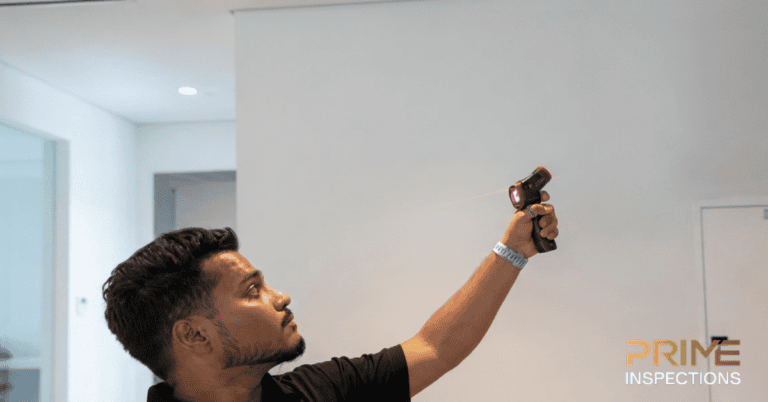
A thermal camera reads surface temperature. A wet patch behind a finished wall, or a cold chilled water pipe sweating in a void, shows up as a temperature signature the eye cannot see. It lets us follow the cold or damp trail back toward the source without cutting anything. We go into this in more detail in our guide on thermal imaging in a standard snagging inspection.
Moisture meters
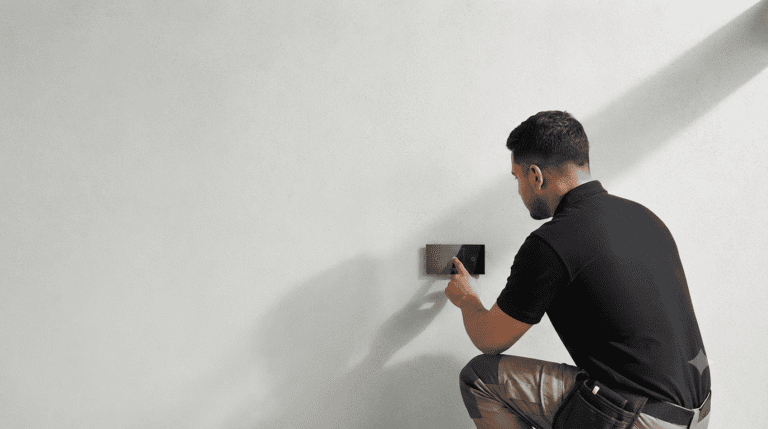
Non-invasive and pin-type meters give a reading, a number, measured against a dry reference elsewhere in the room. That turns it looks damp into this reads wet and the wall two metres away reads dry. A number is far harder to argue with than an opinion.
Humidity and dew point readings
This is the single most valuable measurement in a Dubai leak investigation, because it separates a genuine leak from condensation. If a surface is colder than the dew point of the air around it, the surface will sweat, and no amount of plumbing repair will ever stop it. Reading the dew point is how we tell a real leak from a sweating pipe.
Tracer and dye testing
When we need to know exactly which fixture, which line or which unit is responsible, tracer and dye testing isolates it. It answers the question that starts arguments between neighbours, with evidence instead of assumption.
Borescope inspection
A borescope is a small camera on a probe. Through a tiny access point we can look inside a ceiling void or a wall cavity and see the pipe, the pan or the insulation, without demolishing the finish you paid for.
Why the alternative is a contractor with a hammer
The default method in Dubai is to open the ceiling and look. It is worth being honest about what that costs you. It destroys the finish. It destroys the evidence of where the water came from. And because the water is rarely directly above the stain, it very often opens the wrong ceiling entirely, leaving you with a hole, a bill and a leak that is still running. Instruments first, hammer last, and very often the hammer is never needed at all.
How Long Before It Becomes a Mould Problem?
Not long, and this is not a scare tactic. The widely used guidance, from the United States Environmental Protection Agency, is that wet materials should be dried within 24 to 48 hours to prevent mould taking hold. After that window, mould begins to colonise the damp material. You can read the EPA guidance on mould and moisture for the detail.
In Dubai the point is sharper, not softer. Warm air and high humidity are exactly the conditions mould prefers. A ceiling void that stays damp through a Dubai summer is close to ideal for it. So the honest reason to act today rather than next week is not sales pressure. It is that the drying clock is already running, and the source has to be found and stopped before anything can be dried out properly.
The Leak That Was Not a Leak
One pattern comes up again and again, and it is worth telling because it is so counter-intuitive.
An owner finds a damp patch on the ceiling, near the corner of a bedroom. The bathroom of the apartment upstairs sits more or less above it. The conclusion feels obvious. It must be the neighbour’s bathroom. So begins one of the more uncomfortable conversations in apartment life, the one where you knock on a stranger’s door and suggest their plumbing is ruining your ceiling. It rarely goes well, and it is hard to take back.
Then the thermal scan tells a different story. The cold trail does not lead to the bathroom at all. It runs along a chilled water line, several metres away, in a completely different direction. The insulation on that line had been lapped short at a joint during construction. The bare section of pipe had been sweating quietly since the day the building was commissioned. Every summer it dripped, the drips tracked along the slab, and they surfaced in the one corner nobody would ever have guessed.
It was never a leak. It was a snag. And because it was a construction defect, it was the developer’s to fix, not the neighbour’s and not the owner’s.
The plumber would never have found it. The neighbour was innocent the whole time. And the answer had been sitting in the ceiling void from the very beginning.
A Word on the Neighbour Upstairs
Get the diagnosis before you knock on the door. This is the most useful piece of neighbourly advice we can give.
An accusation about a leak is hard to walk back, and it can sour a relationship with someone you will share a wall with for years. We have watched more than one friendship between neighbours end over a leak that turned out to have nothing to do with the neighbour at all.
An independent inspection settles it before anyone has to have the awkward conversation. If the source really is upstairs, you now have evidence, which is a far better way to raise it than a guess. And if it is not, you have saved yourself an apology and saved a relationship. It costs less than the apology.
Frequently Asked Questions
Who is responsible for a water leak in a Dubai apartment?
Whoever owns the place the water starts from. Inside your unit it is usually you, unless it is a construction defect and you are inside the liability period, in which case it is the developer. In the common parts it is the Owners Association. In another unit it is that owner.
Is the developer responsible for a water leak after handover?
Often, yes, if the cause is a construction or installation defect and you are still within the liability period. Under Article 40 of Dubai Law No. 6 of 2019, developers carry a one-year responsibility for installations from handover and a ten-year responsibility for structural defects from the completion certificate. Report it in writing while the clock is still running.
What if the leak is coming from the apartment above?
Then it is generally the responsibility of that unit’s owner, or the developer if it is a construction defect within the window. But confirm the source before you accuse anyone. It very often is not the flat above, even when it looks like it must be.
Who pays for a leak that comes from a common area?
The Owners Association or management company, because the common parts, such as risers, roofs, podiums and shared chilled water lines, are their responsibility to maintain. The developer may also be liable if it is a construction defect within the applicable window.
How do you find the source of a water leak without breaking the ceiling?
With instruments. Thermal imaging, moisture meters, humidity and dew point readings, tracer testing and a borescope will locate almost any leak without demolition. Opening the ceiling is the last resort, not the first step.
Does the defects liability period cover water leaks?
It can, when the leak is caused by a construction or installation defect. Installations are generally covered for one year from handover, and structural issues for ten years from the completion certificate, under Dubai Law No. 6 of 2019. A leak caused by ordinary wear or your own damage is not covered.
How quickly does mould grow after a leak in Dubai?
Fast. General guidance from the US Environmental Protection Agency is that wet materials should be dried within 24 to 48 hours to prevent mould. Dubai’s heat and humidity make that window tighter, not more forgiving.
Is condensation from a chilled water pipe considered a defect?
If the pipe is sweating because its insulation is missing, damaged or badly fitted, then yes, that is a workmanship defect, not normal behaviour. A correctly insulated chilled water line should not drip. This is one of the most common problems owners wrongly assume is their own to fix.
Find the Source Before Anyone Opens a Ceiling
If you have water coming in right now, the most useful thing we can tell you is that we are open 24 hours a day, Monday to Saturday.
A water leakage inspection puts an inspector on site with a thermal camera, moisture meters and dew point instruments, so the source is found before a single ceiling is opened. That protects your finishes, protects the evidence, and tells you exactly who is responsible for the repair.
Prime Inspections and Snagging is an independent, RERA approved and InterNACHI certified inspection company, and our inspectors are qualified engineers, not general technicians. We cover Dubai and all seven emirates.
| Book a Water Leakage InspectionCall or WhatsApp: +971 50 602 1830Email: connect@primeinspections.aeBook online: primeinspections.ae water leakage inspectionVisit: Office 1914-203, The Binary by Omniyat, Business Bay, Dubai, UAEHours: Open 24 hours, Monday to Saturday |
Disclaimer: This article is general information based on our inspection experience in Dubai and the UAE. It is not legal advice. Responsibility for a leak, and the way the defects liability period, decennial liability and tenancy law apply, depends on the specific facts of your property, your sale and purchase agreement and your tenancy contract. For a binding view, consult a qualified UAE lawyer or the Dubai Land Department. Legal references were accurate at the time of writing, and legislation can change.