Neighbours’ Water Is Leaking Into Your Unit in Dubai: Who Is Responsible and What to Do

A July call from the owner of a one bedroom on Bluewaters Island. A brown ring on the bedroom ceiling that grew overnight and shrank by the afternoon, then grew again the next night.
The neighbour above had checked and insisted their floor was dry. The building technician had been up twice, looked at the stain, and called it condensation both times. Nobody was being difficult. Everyone was guessing.
The detail that mattered was the one nobody had written down: the stain moved with the cooling cycle, not with anyone’s shower. (We cover a near-identical pattern in What to Do When Damp Appears on a Ceiling in Your Apartment.)
A stain that grows overnight and recedes in the afternoon usually points at the ceiling void, not at the unit above. And the ceiling void, in most Dubai towers, is not your neighbour’s problem or yours.
The short answer: who is responsible?
Responsibility follows the failed component, not the damaged room. If the failure sits in common property, meaning risers, soil and waste stacks, structural slabs, the external envelope, podium and roof waterproofing or shared service ducts, it belongs to the Owners Association or the appointed Management Company. If it sits in a private lot, meaning in unit pipework, appliances or wet area waterproofing, it belongs to that unit’s owner.
Law No. 6 of 2019 sets that boundary in Dubai. Everything else in this dispute is downstream of it, which is why establishing where the failed component sits comes before any conversation about money — which is exactly what a Water Leakage Inspection is built to establish.
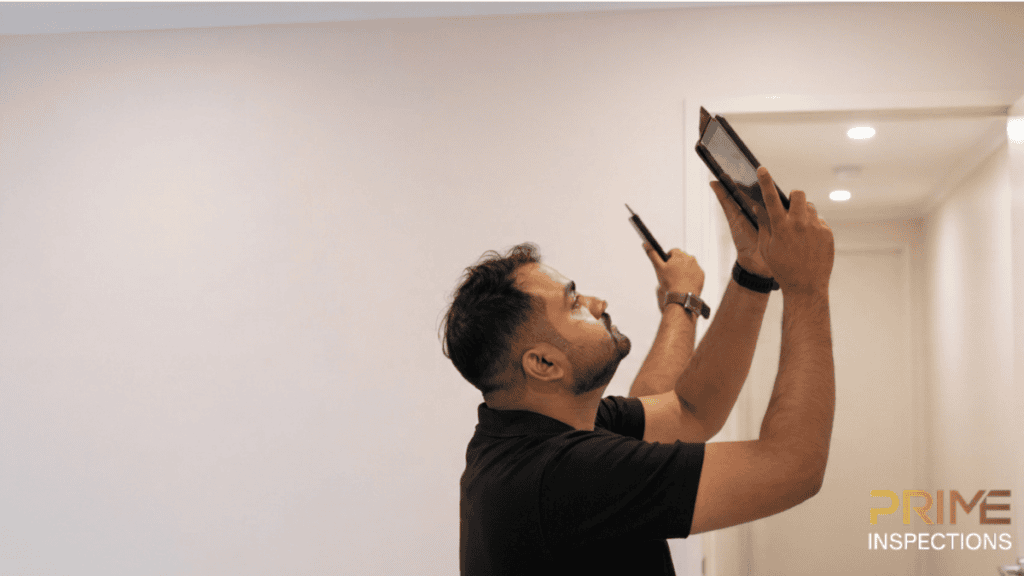
Common property versus private lot: the boundary that decides everything
Get this wrong and you spend weeks knocking on the wrong door.
What counts as common property
Broadly, anything serving more than one unit or forming part of the building itself:
- Risers and vertical service shafts
- Soil and waste stacks
- Structural slabs and columns
- The external envelope, including facade and windows in most schemes
- Podium and roof waterproofing
- Shared service ducts
- Common ceiling voids and the services running through them
These are the Owners Association’s responsibility, funded through service charges administered on Mollak, the RERA service charge platform. Where no owners board is active, the appointed Management Company carries the function. For buildings where the whole common structure is in question, a Complete Building Inspection is the appropriate scope rather than a single-unit visit.
What counts as a private lot
Broadly, what is inside your walls and serves only you:
- Supply and waste pipework after the isolation point into the unit
- Appliances, flexible hoses and water heaters
- Bathroom and kitchen wet area waterproofing
- In unit fixtures, taps, traps and floor drains
Note where wet area waterproofing sits. It is a private lot item in most schemes, which is why a failed bathroom tanking in the unit above is that owner’s liability rather than the building’s.
| Where the water is coming from | Responsible party | First contact |
|---|---|---|
| Bathroom waterproofing failure in the unit above | That unit owner | Owners Association, who coordinate access |
| Failed flexible hose or pipe joint in the unit above | That unit owner | Owners Association |
| Overflowing or blocked floor drain in the unit above | That unit owner | Owners Association |
| Soil stack or riser leak inside a shaft | Owners Association or Management Company | Management Company |
| Chilled water pipework in the ceiling void | Owners Association or Management Company | Management Company |
| Fan coil or condensate drain serving your own unit | You | Your own contractor, or developer if inside DLP |
| Facade or window ingress during rain | Owners Association, usually | Management Company |
| Podium or roof waterproofing above a lower floor | Owners Association | Management Company |
| Slab penetration allowing lateral travel | Depends on the failed component | Independent inspection first |
We investigated a case where the water was genuinely coming from the unit above, and the neighbour did not dispute it. But the component that had failed sat inside a shared service duct passing through their apartment, not in their private plumbing. That single fact moved responsibility to the building even though the water had travelled through a private lot to reach the complainant.
The location of the failed component decides responsibility. The location of the stain does not.
Where the water is actually coming from
Ordered by how often we find them, which is our own field observation rather than an industry figure.
- Wet area waterproofing failure above. Tanking that was never continuous at the perimeter, or was punctured during fit out. Symptom is a stain that grows with use of the bathroom above and stabilises when it is not used. Fit-out related tanking punctures are exactly what a Contractor Work Inspection is designed to catch before handover.
- Failed pipe joint or flexible hose above. Flexible hoses under vanities and behind washing machines are a common failure point. Symptom is often sudden rather than gradual.
- Blocked or overflowing floor drain above. Water escapes the wet area, crosses the threshold and finds the slab. Symptom is intermittent and tied to heavy use.
- Chilled water pipework or fan coil condensate in the ceiling void. The Dubai specific source almost nobody considers. Insulated chilled water lines run above ceilings, and where insulation is damaged or incomplete, condensation forms on the cold pipe and drips. It looks exactly like a leak from above.
- Blocked condensate drain. The fan coil tray backs up and overflows into the ceiling. Symptom is tied to AC runtime.
- Facade or window ingress during rain. Seasonal, appears within a day of a storm, usually at an external wall or window head.
- Podium or roof waterproofing above a lower floor. Affects units directly under a terrace, podium or roof, often with a wide diffuse signature rather than a point source. In villa communities this is often the same waterproofing scope covered under a Pool Inspection where a rooftop or podium pool sits above living space.
- Slab penetration allowing lateral travel. Water enters at one point, runs along the top of the slab or through the screed, and emerges metres away.
That last one is the reason so many of these disputes go wrong. Water follows the path of least resistance, which means the stain is rarely directly under the source.
We inspected a tower unit where the damp signature ran as a horizontal band above the corridor ceiling line, nowhere near the neighbour’s wet area. The owner had spent three weeks in a stalemate with a neighbour who had done nothing wrong. The source sat in the common ceiling void.
Map the shape of the moisture before you knock on anyone’s door.
How we prove it: thermal imaging, moisture mapping and testing
We work only for homeowners, never for developers or real estate agents, and in a leak dispute that neutrality is the product (read more About Us, and how we handle your data in our Privacy Policy). The Owners Association would prefer this to be a private lot problem. The neighbour would prefer it to be a building problem. Our only output is what the instruments say the same disciplined, step-by-step method we follow across our inspection process.
Thermal imaging
We scan ceilings, walls and floors to map the moisture signature and see the shape and extent of the affected area, including parts that look dry.
The honest caveat, which trade sites rarely give you: thermal imaging shows temperature difference, not water. Evaporative cooling from damp material produces a signature, but so do other things. Thermal narrows the search and reveals the shape. It does not on its own prove a leak, and it always needs corroboration.
Moisture meter and hygrometer readings
Pin and pinless moisture readings confirm and quantify what thermal suggested, taken as a grid so the results are comparable rather than anecdotal. Hygrometer readings record ambient temperature and humidity, which is how we test the condensation hypothesis properly instead of asserting it.
Dye testing
Where a specific fixture or drain path is suspected, a traced dye confirms or eliminates it. It is simple, non destructive and hard to argue with.
Pressure testing
For a suspected supply line, isolating and pressure testing establishes whether the line holds. A line that will not hold pressure is a finding, not an opinion.
The timeline log
The least technical tool and often the most decisive. Date, time, stain dimensions, ambient conditions, and any known activity in adjacent units.
We had a case where the leak only appeared after two consecutive days of the neighbour being at home, which nobody had noticed until the owner started logging stain size against dates. The pattern emerged in under two weeks.
A timeline is evidence, and it costs nothing.
Not sure whether the source is common property or your neighbour’s unit? Send us a photo of the stain and the date it started. WhatsApp for an instant quote.
What to do in the first 48 hours
- Photograph everything before anything is wiped, dried or repainted. Wide shot plus close up, with the date on the file.
- Measure the stain and mark its edge in pencil. Re measure and re photograph daily from the same position.
- Note ambient conditions and what the AC is doing, since that separates a condensation signature from a plumbing one.
- Notify the Owners Association or Management Company in writing. Not by phone, not in a WhatsApp group. Email creates a dated record.
- Notify the neighbour politely in writing and request access for an inspection.
- Open a file with your insurer even before the source is confirmed. Late notification is a common reason claims stall.
- Authorise no repair, no repaint and no ceiling closure until the source is confirmed and documented.
- Move and photograph damaged belongings, and keep them rather than disposing of them.
- If water is actively running, ask the Management Company to isolate the relevant supply. That is a building function, not something to attempt yourself.
The repaint point deserves emphasis. Repainting is the single most common self inflicted wound in these cases. It destroys the evidence, and the stain comes back anyway.
Getting access when the neighbour says no
Start from the assumption that your neighbour is not the problem. In most cases they are as inconvenienced as you are, and a first approach that reads as an accusation usually costs you the access you need. This applies just as much if you’ve recently bought the unit — a pre-purchase Resale Property Inspection won’t always catch a leak that only appears intermittently, so new owners are often the ones navigating this exact conversation.
An owner cannot force entry into another unit. What you can do is create a documented, reasonable request and route it through the party whose job it is to coordinate: the Owners Association or Management Company, which holds the coordinating role for the building under the jointly owned property regime.
Script one, to the neighbour:
Dear [neighbour], I am the owner of apartment [number], directly below yours. Since [date] we have had a damp area on the ceiling of [room], which I have photographed and measured daily. I am not assuming the source is in your apartment, and it may well be in the building services. To rule it out, I have asked [Management Company] to arrange an inspection of both units by an independent inspector. Would you be willing to allow access on [two proposed dates]? I will share the report with you in full either way. Please let me know by [date].
Script two, to the Owners Association or Management Company:
To [Management Company], I am reporting active water ingress into apartment [number], first observed on [date], affecting [room and area in square metres]. Dated photographs and daily measurements are attached. The source has not been confirmed and may lie in common property, including the ceiling void, riser or stack serving this line. I am requesting: (1) inspection of the common services on this line, (2) coordination of access to apartment [number above] for an independent inspection, and (3) written confirmation of your findings. Please respond by [date, allowing a reasonable period].
Two things make these work. Neither accuses anyone, and both carry a requested response date, which starts a clock you can point to later.
Worth knowing: evidence gathered entirely from your own side, thermal mapping, moisture grids, the timeline, often narrows the source enough to identify whether it is common property without ever entering the unit above. Access is helpful. It is not always necessary.
Insurance: three policies, three answers
Liability and insurance cover are separate questions, and confusing them wastes a lot of time. Who caused it and whose policy pays are frequently different answers.
- The building or Owners Association policy. Typically responds where the failure is in common property, and often covers the building structure and sometimes original fixtures. Claimed through the Management Company.
- Your own home or unit owner policy. Typically responds for the private lot and for reinstating your finishes, ceilings, paint and flooring. Subject to your policy’s excess and terms.
- Your contents policy. Responds for belongings, furniture and electronics, which the building policy will not touch.
Three practical points. Every policy carries an excess, so a small claim may not be worth opening. Insurers ask for a cause of loss, which means they want to know what failed and where, not just that water arrived. And they consistently want an independent assessment rather than the neighbour’s view or the building technician’s verbal opinion.
We saw a claim stall for weeks on undated, unlabelled phone photographs. What moved it was a severity scored report with thermal imagery, moisture readings and a dated sequence attached.
Insurers and Owners Associations respond to structure, not to urgency.
We produce reports that Owners Associations and insurers accept, with thermal imagery, moisture readings and severity scoring. Book a water leakage inspection.
Escalation when nobody acts
- Written notice with a deadline. To the Owners Association or Management Company, referencing your first report date, attaching the evidence, and requesting a written response by a stated reasonable date. If this stage stalls, our note on what to do when a developer or manager goes quiet walks through the follow-up pattern that actually gets a response.
- Escalate within the Management Company. Above the site team to the account manager or operations lead. Site technicians are often not empowered to authorise investigation into common services.
- RERA and the Dubai Land Department. Jointly owned property and service charge matters route here, through the Dubai REST app or the Dubai Land Department (DLD) website. The DLD call centre is 800 4488. Service charges themselves are administered through Mollak.
- Dubai Municipality. The right authority where the concern is building code compliance or structural safety rather than a service dispute.
- Dubai Courts. For a civil damages claim. Claims above AED 100,000 generally require a report from a DLD registered property consultant, commonly in the region of AED 5,000 to AED 15,000. Filing fees are percentage based with a cap commonly cited near AED 40,000, and timelines typically run six to eighteen months or longer. Verify all of these before relying on them.
The correction that saves the most time: the Rental Disputes Centre handles landlord and tenant disputes only. It is not the route for an owner versus owner leak, and not the route for a dispute with your Owners Association. A great deal of published advice gets this wrong.
There is one honest exception. If you are a tenant and your landlord will not act on damage in the unit you rent, that is a landlord and tenant matter, and the Rental Disputes Centre may be the relevant forum for your side of it. The dispute over the source of the water is still not.
If it is a new building: DLP and decennial liability
In a recently handed over tower, the developer may still carry the defect regardless of the strata boundary — which is exactly why so many owners book a New Handover Snagging inspection before the DLP clock even starts.
Inside the Defects Liability Period, commonly twelve months, waterproofing and plumbing failures usually remain the developer’s to rectify. That period is contractual under your SPA, not statutory, so read the clause rather than assuming a standard length.
Separately, decennial liability runs ten years from handover of the works under Article 821 of Federal Decree-Law No. 25 of 2025, previously Article 880 of Federal Law No. 5 of 1985. Article 823 voids any contract clause attempting to exclude or limit it, and Article 824 requires a claim within three years of discovery.
Be realistic about which applies. Decennial covers collapse and defects threatening structural stability and safety. A leak from a failed hose is a contractual defects matter. A water path that has progressed to threatening the structure is a different conversation, and a rarer one.
What it costs
Inspection fees are quoted by unit type. As market ranges only, request a quote for your property:
| Property | Market range |
|---|---|
| Studio or 1 bedroom | AED 800 to AED 1,200 |
| 2 bedroom | AED 1,200 to AED 1,800 |
| 3 bedroom | AED 1,800 to AED 2,500 |
| Townhouse | AED 2,500 to AED 3,500 |
| Villa | AED 3,500 to AED 6,000 and above |
Weigh that against what is actually in dispute. A ceiling reinstatement, flooring, joinery and contents in a mid sized apartment runs well beyond an inspection fee, and the argument over who pays it can run for months. The report is usually the cheapest item in the whole matter and the only one that ends the disagreement rather than extending it.
Frequently asked questions
Who pays when water leaks from the neighbour’s apartment in Dubai? Whoever owns the failed component. If it is the neighbour’s in unit plumbing or wet area waterproofing, it is theirs. If it is a riser, stack or service in common property that happens to pass through their unit, it is the Owners Association’s. Law No. 6 of 2019 sets that boundary.
Is a leaking riser the Owners Association’s responsibility? Yes. Risers, soil and waste stacks and shared service ducts are common property, so the Owners Association or the appointed Management Company is responsible for investigation and repair, funded through service charges. Report it to the Management Company in writing rather than approaching the neighbour whose unit the riser passes through.
What if my neighbour refuses access? You cannot force entry. Send a polite, dated written request, then route it through the Owners Association or Management Company, whose coordinating role covers exactly this. In parallel, thermal mapping and moisture readings from your own side often narrow the source enough without needing to enter at all.
How do you find a leak source without breaking tiles? Thermal imaging maps the moisture signature, moisture meters confirm and quantify it as a grid, dye testing traces a suspected fixture or drain, and pressure testing checks a supply line. Together they usually locate a source non invasively, so opening up is targeted rather than exploratory.
Does home insurance cover water damage from a neighbour in the UAE? Often yes, subject to your policy and excess. Your home policy typically covers reinstating your finishes, your contents policy covers belongings, and the building policy responds where the failure is in common property. Insurers want a cause of loss, so an independent report matters more than a verbal account.
Can I go to the Rental Disputes Centre for a leak from another apartment? No. The Rental Disputes Centre handles landlord and tenant disputes only. It does not hear owner versus owner or owner versus Owners Association matters. Those route through the Owners Association, then RERA and the Dubai Land Department, and ultimately Dubai Courts for a civil damages claim.
How long does leak tracing take? A non invasive investigation of a single apartment usually takes a few hours on site, with the report following within 24 hours. Where the pattern is intermittent, a timeline log run over one to two weeks alongside the inspection is often what confirms the source rather than the single visit.
What evidence do I need? Dated photographs from the first day, daily stain measurements, a written log of ambient conditions and adjacent unit activity, copies of every written notification with dates, and an independent report with thermal imagery and moisture readings. Undated phone photos are the most common reason claims stall.
Who repairs my ceiling and my furniture? Reinstatement of your ceiling and finishes usually falls to your own home policy or to the liable party once the source is confirmed. Furniture and belongings sit with your contents policy. Neither is normally covered by the building policy, which is why the three policy distinction matters.
Can the Owners Association charge me for the repair? Not for repairing a common property failure, which is a service charge funded obligation. They can charge you where the failed component is inside your private lot and the damage extends into common areas or another unit. Establishing which applies is exactly what the independent report settles.
The engineer’s view, and what to do next
Most of these disputes are not lost because the owner was wrong. They are lost because the owner argued before they had evidence, and by the time the evidence existed the stain had been painted over, the dates were approximate and everyone had already taken a position.
You do not need to win the argument on day one. You need to photograph, measure, log and notify in writing, and let the instruments settle the rest.
Our water leakage inspections use thermal imaging, non invasive moisture scanning and moisture metering, carried out by InterNACHI certified, RERA certified inspectors, with a photo based digital report, temperature maps and severity scoring within 24 hours, written to be handed to an Owners Association, a Management Company or an insurer without argument. Clients rate us 4.9 out of 5 across 108 Google reviews, and the line that comes up most is the one that matters here: “The exact source of the problem was identified.”
Speak to our engineer on +971 50 602 1830 before you repaint anything, or get in touch to view our free sample report first.
Mohammed Nadeem Maldar, Engineering Manager, Prime Inspections and Snagging.