How to Time Snagging Within the DLP for Maximum Leverage

It was 4:10 on a Tuesday afternoon in August, inside a three bedroom townhouse in Dubai Hills Estate. The owner had collected the keys the previous October, and our inspector Malik had done the handover snagging then.
Now the family had lived through one full summer. The outside wall was hot to the touch. The AC was running hard.
The owner met Malik at the door with a question about snagging within the DLP that we hear every summer: “We are in month ten. Is there still time to get everything on the developer’s list, or have we left it too late?”
The strongest way to time snagging within the DLP is two rounds. Do the first at handover, before you sign. Keep a dated log for nine months. Book the second inspection in month nine or ten, ideally after summer AC use, so the developer still has time to fix everything before the period ends.
That is the short answer. The rest of this post explains why it works, where the clock starts, and how to keep every report counting as evidence.
At Prime Inspections & Snagging we inspect and report. We do not repair, and we do not give legal advice. So the legal points here are general, and your own contract always comes first.
What Is the DLP in Dubai and What Does It Cover?
The defects liability period (DLP) is the window after handover when the developer is responsible for fixing certain defects at no cost to you.
In Dubai it is usually twelve months for installations. Good timing starts with knowing what falls inside it.
What the 12-month period usually covers
In most cases the one-year period covers defective installations and fittings. That means AC units and ducting, plumbing, drainage, electrical circuits, sockets and switches.
It also tends to cover doors, windows, sealants, finishes and waterproofing that fails because of how it was installed. If something was built or fitted wrongly, it usually belongs here.
What it does not cover
Normal wear and tear is not a defect. Nor is damage caused by the owner, a tenant or a moving company.
Your own fit-out work, and anything a tenant changed, also sits outside it. A dated report from early on helps separate original defects from later damage.
Where the 10-year structural cover fits
Structural parts are treated separately. Under Article 40(a) of Dubai Law No. 6 of 2019, the developer stays liable for structural defects for ten years from the completion certificate. This is often called decennial liability.
This post focuses on the one-year window, because that is where timing makes the biggest difference.
When Does the DLP Clock Actually Start?
This is the question owners get wrong most often. And it shapes every date in your plan.
What Law No. 6 of 2019 says
Article 40(b) of Dubai Law No. 6 of 2019 on jointly owned property sets the one-year period for installations.
In plain English, the year runs from the day the unit is handed over to the owner. So for most apartment owners, the handover date is day one.
Why refusing the keys does not pause it
The same article covers owners who do not take possession. If an owner refrains from taking the unit for any reason, the one year can start from the completion certificate date instead.
Many owners assume that leaving the keys with the developer stops the clock. Generally, it does not. Waiting can quietly shorten the time you have.
Why your SPA still matters
Contracts are not all worded the same way. Some villa communities and some SPAs run the period from completion rather than handover.
We usually suggest a simple rule: check your SPA, and if in doubt, plan around the earlier date. Our guide to the defects liability period in Dubai covers the detail. For your own case, speak to a lawyer for your specific contract.
The Best Times for Snagging Within the DLP
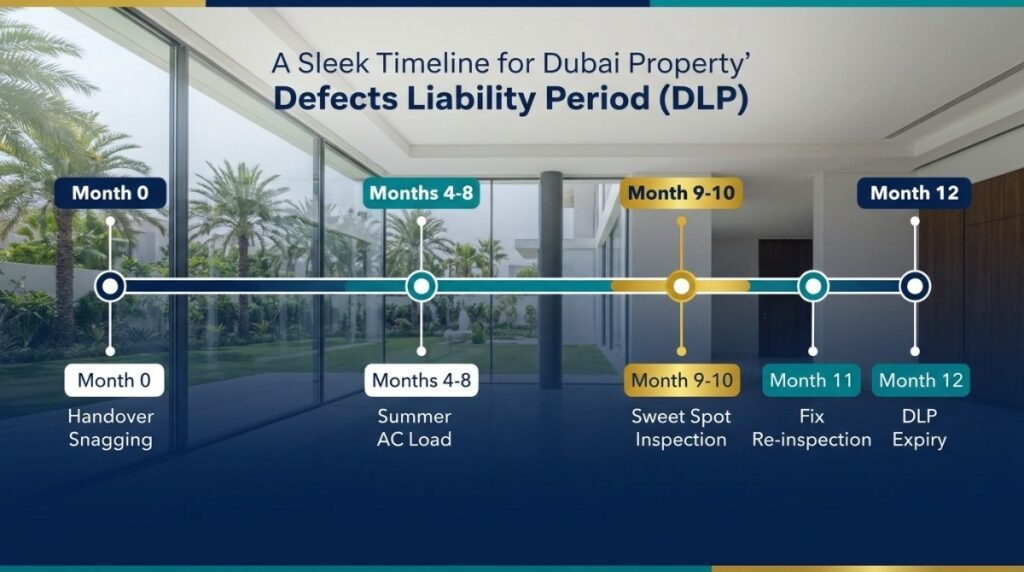
Here is the plan we walk through with most owners. It treats the twelve months as a timeline, not a deadline you react to in month eleven.
| Window | What to do | Why it gives leverage |
| Before signing handover | Round 1 snagging, 250+ checkpoints | The developer still wants to close the unit, and nothing can be blamed on occupation |
| Months 1 to 3 | Report anything new in writing as you find it | Early tickets show the defect is original, not owner damage |
| Months 4 to 8, including summer | Keep a live log of AC, damp, door seals and drainage smells | Summer load reveals condensation, thermal bridging and AC faults |
| Month 9 or 10 | Round 2 independent inspection, one consolidated report | Leaves 8 to 12 weeks for repairs inside the DLP |
| Month 11 | Re-inspection of the round 2 fixes | Confirms closure while the developer still owes the work |
| Month 12 | Written follow-up on anything still open, with a request for a written commitment | Keeps a dated record for items you reported in time |
The two inspection rounds do different jobs. Round 1 catches what was built wrong. Round 2 catches what only shows up with use, and checks whether the first repairs held.
The log in between matters just as much. A home log costs nothing, and it gives round 2 a head start.
If you are close to month nine, this is the point where we usually suggest booking round 2. You can send us your handover date and unit type and we will suggest a slot.
Why Months 9 and 10 Are the Sweet Spot
An end of DLP inspection in month nine or ten balances two things. The home has been used long enough to show its problems. And there is still time to fix them.
Repairs take longer than owners expect
A report is only the start. The developer has to log it, assign a contractor, order materials and arrange access.
Several weeks is common, and longer lists take longer. A report sent in month eleven leaves very little room. A report sent in month nine leaves enough for repairs and a re-check.
Dubai summer shows what handover day hides
From May to September, outside temperatures pass 45C and the AC runs against a hot facade all day. That contrast is when condensation and thermal bridging are easiest to see.
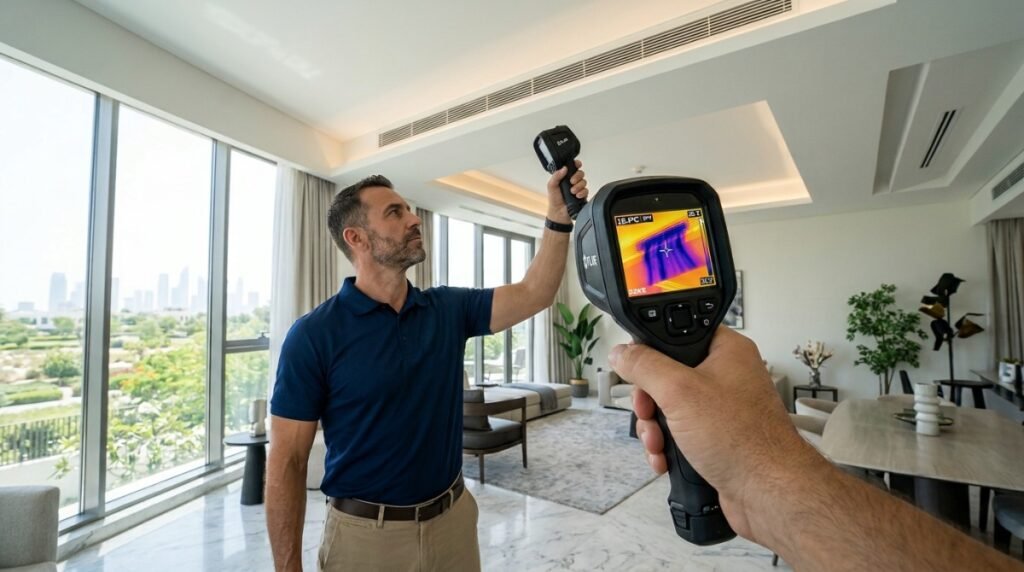
On August jobs we often find condensation lines above AC grilles that simply were not there in winter. Thermal imaging works best with a strong temperature difference, so a summer round 2 is usually more revealing.
For this, district cooling from providers such as Empower, Emicool or Tabreed must be active and the AC must be running.
If your handover was in winter
The ideal round 2 then lands after your first summer, which fits month nine or ten neatly. If your handover was in summer, a month nine or ten round still checks the next season’s issues and every round 1 fix. Either way, the timing holds.
How to Make Every Report Count as Evidence
Leverage during the DLP does not come from a strong conversation. It comes from a clean paper trail. This is what keeps snagging within the DLP useful long after the inspector leaves.
- Use the developer’s official channel, such as the portal, app or customer care email. WhatsApp alone is hard to rely on later.
- Save the ticket or reference number every time.
- Attach dated photos and the inspection report PDF.
- Send one consolidated list, numbered and room by room.
- Ask for a written target date for each item.
- Track each status: open, closed, or closed on paper but not fixed.
- Book a re-inspection before you accept anything as closed.
That last status matters more than it sounds. We see snags marked closed but not fixed on many second visits.
For investor landlords, one more point. A tenant’s message is useful, but it only counts once the owner logs it with the developer.
Common Timing Mistakes We See
Most problems we see in month twelve come from a few habits.
- Treating the handover inspection as the only inspection.
- Reporting defects by phone or chat with no reference number.
- Waiting for a “full list” before reporting anything.
- Assuming the DLP starts on the day the keys were finally collected.
- Booking round 2 in month eleven or twelve.
None of these are unusual. They are just easy to avoid with a plan.
What This Looked Like in a Dubai Hills Estate Townhouse
Back to the townhouse from the opening. It shows the plan working in real life, with real numbers.
What round 1 had already caught
Malik did the handover snagging in October, before the owner signed. The report listed 38 items, from door alignment to sealant gaps and a shower tray with poor falls.
The owner submitted it through the developer’s portal and saved the reference number. You can see the kind of work we do in snagging in Dubai Hills Estate on our community page.
What changed after one summer
In August, Malik went back through every original item. Thirty one of the thirty eight were properly closed.
Four were closed on paper but not fixed. A re-grouted shower tray still showed moisture readings on the meter. Two door closers had not been adjusted, and one sealant line was still open. Three items had reopened.
Then came the new findings. Condensation staining above a bedroom AC grille. A thermal cold spot along the master balcony door frame. Hairline cracks at two window corners.
None of these would have shown on handover day. The house had never been through a summer with the AC running. Round 2 was not a repeat. It caught a different class of defect.
Why timing made the difference
Month ten left eight to ten weeks for repairs. Month twelve would have left almost none.
Our Engineering Manager, Mohammed Nadeem Maldar, puts it simply: “We are not there to argue with the developer. We are there to make sure the list is complete and dated while there is still time to act on it.”
Leverage Without Legal Risk
Some owners ask whether holding back a payment would speed things up. It is an understandable thought, but it carries real risk.
Why withholding payment is risky
Dubai Law No. 13 of 2008, as amended by Law No. 19 of 2017, gives developers remedies when an off-plan buyer does not pay. The developer can notify the Dubai Land Department (DLD), and a 30-day notice follows.
Depending on how complete the project is, the developer may then terminate. It can retain up to 40 percent of the unit’s value above 60 percent completion, or up to 25 percent below 60 percent.
The safer route
Document, notify in writing and negotiate. Keep paying what your contract requires.
If the developer goes quiet, follow up in writing with your reference numbers. DLD complaint channels, such as the Dubai REST app or DLD online services, are there if you need them. Before changing any payment, speak to a lawyer for your specific contract.
Frequently Asked Questions
When is the best time to do snagging within the DLP?
We usually suggest two rounds. The first is at handover, before you sign. The second is in month nine or ten, ideally after a summer of AC use. That timing catches defects that appear with use and still leaves the developer several weeks to repair them inside the period.
Does the DLP start at handover or at the completion certificate?
For installations in jointly owned property, Dubai Law No. 6 of 2019 runs the one year from handover of the unit to the owner. Some contracts word it differently, so check your SPA. If you are unsure, plan your inspections around the earlier of the two dates and speak to a lawyer.
Does refusing to take the keys pause the DLP?
Generally no. The same law says that if an owner refrains from taking possession, the one year can run from the completion certificate date instead. Delaying the keys can shorten your useful window, so it is usually safer to snag, document and plan rather than wait for a better moment.
How do I prove a defect was reported during the DLP?
Report through the developer’s official portal, app or customer care email, and save the reference number. Attach dated photos and the inspection report. One numbered, consolidated list is easier to track than many separate messages, and it gives you a clean record if questions come up later in the year.
Is a second inspection worth it if I have already moved in?
In most cases yes. Living in a home shows defects an empty unit cannot: AC condensation, slow drains, door seals that fail in humidity, small leaks behind fittings. A second round also checks whether the first repairs actually held up after months of daily use.
My tenant reports defects. Does that count?
A tenant’s report is helpful, but the developer usually acts only on tickets raised by the owner or the owner’s authorised representative. Forward each issue through the official channel with photos and keep the reference number. That way the record sits in your name and stays usable if anything is disputed.
Can an overseas owner manage DLP snagging remotely?
Yes. Most owners arrange access through a property manager, building management or a trusted person. The inspector shares a digital report with photos, which the owner then submits to the developer. A short call to walk through the findings usually helps before anything is sent, especially for a long list.
What can I do if the developer ignores DLP complaints?
Follow up in writing with dates and reference numbers, then escalate within the developer’s customer care. If that stalls, DLD complaint channels such as the Dubai REST app are available. Keep paying what your contract requires unless a lawyer advises otherwise, and speak to a lawyer for your specific contract.
Planning Your DLP Year With Prime
The Dubai Hills Estate owner submitted the consolidated report through the developer’s portal that same week, with photos and the reference number saved. Most items were fixed over the next five to six weeks, still inside the DLP.
Two items were still open in month twelve. Because they had been logged in writing with dates, the developer agreed in writing to complete them. The record was clean, and the repairs stayed on the developer’s side.
If you would like to plan your own snagging within the DLP, we are happy to help. Our inspectors are independent, RERA certified and InterNACHI certified, and we work from a 250+ checkpoint list. Reports arrive in 24 to 48 hours.
A handover snagging inspection starts from AED 999, excluding VAT, for a studio or one bedroom apartment, and from AED 3,999, excluding VAT, for a villa. A re-inspection is booked as a separate visit, so please ask for the fee when you book.
If you prefer to talk it through first, call us on +971506021830. Our office is in Business Bay, and we cover Dubai and the other emirates.