Your Snag Report Lists Over 200 Items: What It Actually Means and What to Do Next
August, a five bedroom villa handover in Dubai Hills Estate, ambient well over 45 C. The owner and his wife were standing in the entrance hall while the handover coordinator waited nearby with the acceptance form and a pen.
We sent the report that evening. He called within the hour, and his first words were not “what did you find”.
They were: “Two hundred and fourteen. Is my house broken?”
No. And the reason that number frightened him is the reason this page exists, because nobody had ever explained to him what a snag report is actually counting.
Is a 200 plus item snag report normal in Dubai?
Yes. A snag report with over 200 items is normal on a large Dubai villa or townhouse, where item count scales with rooms, doors and wet areas. The count alone is meaningless — which is exactly why our New Handover Snagging reports lead with severity, not a total.
Sort every item into Category A safety and water ingress, Category B functional and MEP, and Category C cosmetic. The distribution across those three is the actual finding. The total is just arithmetic.
We inspected a large villa in a Tilal Al Ghaf community where the list ran well into three figures, and the overwhelming majority of it was paint touch ups, sealant, tile finish and door adjustments. Category A came to a handful of items.
Volume follows floor area and door count, not build quality.
Why the count is the wrong number
Think about what a 250 plus point inspection is doing across 500 square metres.
Every room gets walls, ceiling, floor, skirting and paint checked. Every door gets alignment, swing, seal, handle, lock and closer. Every window gets operation, seal, glazing and ironmongery. Every socket, switch and light fitting is tested individually. Every wet area gets falls, tanking evidence, grout, sealant, drainage, fixtures and pressure.
A five bedroom villa might have forty doors, sixty windows, a hundred and twenty electrical points and seven wet areas. If you record honestly at that resolution, you generate volume by design.
A one bedroom apartment inspected to exactly the same standard produces a fraction of the items, from exactly the same quality of build.
Count versus severity distribution
The useful question is not how many. It is how many of each.
A report showing 214 items with 4 in Category A, 31 in Category B and 179 in Category C is describing a normally finished villa with a couple of things that need attention before anyone signs anything.
The same 214 with 40 in Category A would be a different property entirely.
What a low count can hide
This cuts both ways, and it is the part owners rarely consider.
We inspected an apartment where the list was short. Well under fifty items, most of them cosmetic. One item was active water ingress at a balcony threshold, with moisture already tracking into the adjacent bedroom — precisely the kind of finding our Water Leakage Inspection methodology is designed to surface even on a “clean-looking” unit.
A 40 item report can be worse news than a 240 item report. Length is not risk.
The severity model, Category A, B and C
| Category | What it covers | Sign before it is closed |
|---|---|---|
| A | Safety, structural, water ingress | No |
| B | Functional and MEP performance | Only with a written rectification schedule |
| C | Cosmetic and finishing | Yes, once A and B are handled |
Category A: safety, structural and water ingress
These are the items that decide whether you sign.
- Exposed conductors, unsafe terminations, missing or untested RCD protection
- Unstable balustrades and handrails, unsafe glazing
- Through thickness or progressive cracks, particularly near columns, beams and slab soffits
- Active leaks and live water ingress anywhere
- Balcony ponding with waterproofing implications
We test these with instruments rather than by eye. A socket and circuit tester for polarity, earthing and RCD trip verification. A thermal imaging camera and moisture meter for ingress. A crack gauge where a crack needs monitoring rather than a verdict on day one.
Defects that threaten structural stability and safety sit under Article 821 of Federal Decree-Law No. 25 of 2025, previously Article 880 of Federal Law No. 5 of 1985, which runs for ten years and cannot be excluded by any contract clause under Article 823. Article 824 gives three years from discovery to bring a claim.
Category B: functional and MEP
Things that work or do not, which mostly means the building services.
- AC delta T shortfall, meaning the supply to return air temperature split is too small
- Uncommissioned or wrongly addressed thermostats
- Closed chilled water isolation valves above ceiling access panels
- An inactive district cooling account, which is not a defect but must be identified rather than recorded as a fault
- Blocked or badly vented drainage, dry P traps
- Water pressure, hot water recovery, extract fans
- Door operation, ironmongery, closers
Category B is where the largest gap sits between what an owner can check and what an inspection measures. You can tell whether air is coming out of a diffuser. You cannot tell whether the delta T is adequate without measuring it.
Category C: cosmetic and finishing
Paint, crazing, hairline shrinkage cracks, sealant, tile lippage, grout, scratches, alignment.
Every one of these is real and claimable inside your defects period. None of them is a reason to delay a signature once A and B are dealt with. This is the category that inflates the number and worries people the most, which is exactly backwards.
What is a defect and what is normal
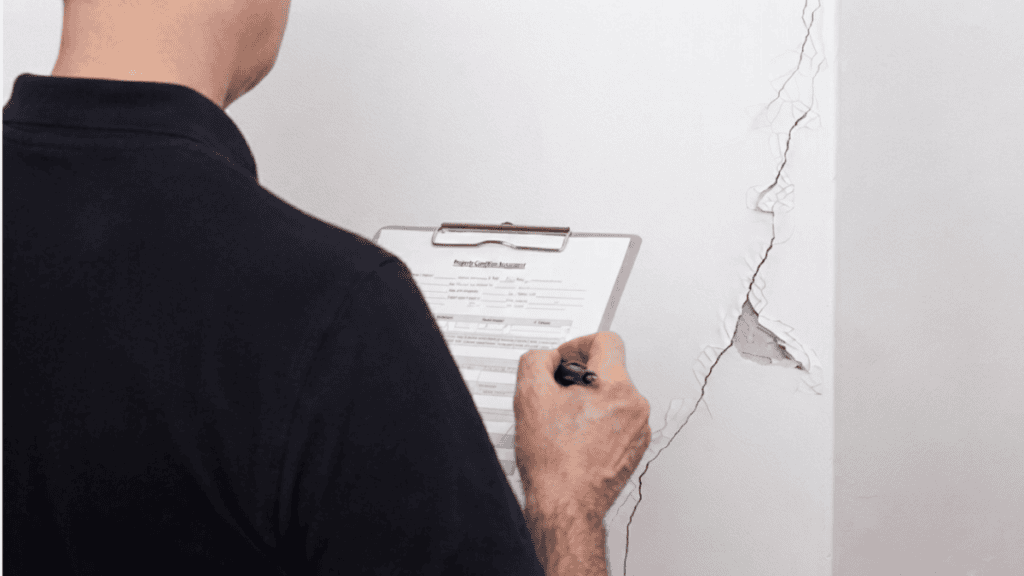
Cosmetic is a conclusion, not an assumption. A hairline crack is Category C once somebody has established it is shrinkage, and the tests for that are specific:
- Width, measured against a scale, though width alone decides nothing
- Pattern and direction, since diagonal cracks at openings behave differently from vertical cracks in a wall panel
- Whether it crosses different materials, because drying happens within a material and movement does not respect boundaries
- Whether it is progressive, measured with a crack gauge over weeks
- Whether moisture is present, checked with a moisture meter and thermal imaging
A live crack under filler and paint is not cosmetic. It is a Category C label attached to a Category A problem, which is the most expensive mislabelling available.
Want to see how severity scoring looks in practice? View our free sample report.
How to sort the list so the developer can act
A long report is not the obstacle. An unsorted one is.
Sort one: by room, for you
This is how you walk the property and verify. Room by room, in the order you would move through the unit, so nothing gets missed on a re-check.
Sort two: by trade, for them
This is the sort that decides how fast the work happens.
Group every item under the trade that will fix it: painter, tiler, joiner, electrician, plumber, HVAC technician, glazier, waterproofing specialist.
We regrouped a townhouse list this way and the difference was immediate. Instead of a foreman reading through a chronological list and guessing at scheduling, the developer sent one painter, one electrician and one joiner, each with their own portion of the work.
The format of the list decides how fast it gets fixed.
The one page summary
Whatever the length of the full report, the covering page should carry:
- Counts per category, A, B and C
- Category A listed in full, on that page
- Access and utility dependencies, such as items that could not be tested because DEWA or district cooling was not live
- A requested closure date
That page is what a customer care manager actually reads. The other forty pages are the evidence behind it.
What to send the developer and how
Send one PDF. Not a folder of photographs, not a spreadsheet plus an album, not fifteen WhatsApp messages.
Include:
- Room labelled and measured photo evidence, dated
- Reference to your SPA defect clause and the Defects Liability Period
- A named recipient rather than a general inbox
- A request for a written rectification schedule, not just an acknowledgement
Rectification of documented snags commonly runs around four to five weeks in this market from written notice to completion. That is our field observation across UAE handovers, not a legal deadline, and your SPA may specify something different.
Ask for the schedule in writing at the outset. It converts an open ended obligation into a set of dates you can follow up against.
Signing the handover acceptance with an open list
Here is the part that matters most on the day.
The Defects Liability Period clock and your acceptance of the unit’s condition attach to the date you sign the handover acceptance form. Not to key collection, not to the appointment, not to final payment.
Which gives you a straightforward rule. Do not sign while Category A is open. Category B should carry a written rectification schedule before you sign. Category C should not hold up a signature at all, provided it is recorded on the list.
Your snagging window is set by your SPA. Seven to fourteen days is commonly quoted and repeated everywhere, but there is no published mandated period in Dubai. Read your own defects clause, including the start date, because agreements differ on both.
Meeting the submission deadline and deferring the signature are two separate actions. You can do both.
De-snag: verifying what was actually fixed
Rectification gets marked complete on a system. That status is a claim.
A de-snag inspection revisits each item and photographs it from the same angle as the original finding, dated, so you are comparing like with like rather than reading a spreadsheet column.
We have run re-inspections where a proportion of the items marked closed were closed on paper only. Filler and paint over a crack nobody had investigated. A door adjusted so it latched but still out of square. A sealant line replaced without the underlying gap being addressed.
Verification is part of the job, not an upsell.
To reopen a disputed item, send the original finding photograph and the de-snag photograph side by side with both dates, and state plainly why the condition is unchanged. That comparison is very difficult to argue with, and it is why the same camera position matters.
Book a re-inspection and get every closed item verified in writing. Book an inspection now.
If the developer disputes or ignores the list
- Written dated notice. To the developer or main contractor, with the PDF attached, citing the SPA defect clause and the DLP.
- Customer care, then head of customer experience. In writing, one thread, referencing your original submission date. Most cases end here. We saw one where a developer initially pushed back on the volume of items, and the position changed once the one page summary was resent showing four Category A items listed in full and the rest sorted by trade. The dispute was about the appearance of the list, not its contents. If it drags on further, our note on what to do when a developer ignores your snag list covers the next steps.
- RERA and the Dubai Land Department. Via the Dubai REST app or the DLD website violations route. The fee is commonly cited at AED 1,000 per complaint, with an initial response in about five working days and admission roughly seven to fifteen days once documents are complete. The decision target is around 60 days. Verify current figures and treat the timings as targets.
- Dubai Courts. Claims above AED 100,000 generally need a report from a DLD registered property consultant, commonly around AED 5,000 to AED 15,000. Filing fees are percentage based with a cap commonly cited near AED 40,000.
Two corrections worth stating. The Rental Disputes Centre handles landlord and tenant disputes only and does not hear buyer versus developer defect claims. Dubai Municipality is the right authority for building code and structural safety concerns. The DLD call centre is 800 4488.
What this costs
Inspection ranges by unit type, as market ranges only, request a quote:
| Property | Market range |
|---|---|
| Studio or 1 bedroom | AED 800 to AED 1,200 |
| 2 bedroom | AED 1,200 to AED 1,800 |
| 3 bedroom | AED 1,800 to AED 2,500 |
| Townhouse | AED 2,500 to AED 3,500 |
| Villa | AED 3,500 to AED 6,000 and above |
Apartments take two to four hours on site. Luxury villas take four to eight. Reports arrive within 24 hours with severity scoring and a developer ready rectification checklist. If DEWA or district cooling has not been activated on the day, that limitation gets recorded rather than guessed at — see our note on what to do when DEWA is not connected on inspection day for how a partial report is labelled and completed once utilities are live, and confirm current activation figures on dewa.gov.ae.
Worth being direct about the suspicion behind the question. A long list does not make us more money, and it costs us more to produce. Our interest is a report the developer accepts without argument, which is a function of structure and evidence rather than length.
Frequently asked questions
Is 200 snags a lot for a new property in Dubai? Not for a large villa or townhouse. Item count scales with rooms, doors, windows, electrical points and wet areas, so a five bedroom villa inspected to the same standard as a one bedroom apartment will always produce several times more items. The severity distribution is what matters.
How many snags is normal at handover? There is no meaningful industry figure, and anyone quoting one is generalising across property sizes that are not comparable. Judge your report by how many items fall into Category A safety and water ingress, not by the total at the bottom of the page.
Does a long snag list mean the developer is bad? Not by itself. Volume tracks property size and inspection thoroughness more closely than it tracks build quality. A short list from a superficial walkthrough tells you far less than a long list from a detailed inspection. Look at what is in Category A.
How do I prioritise a snag list? Sort every item into Category A safety, structural and water ingress, Category B functional and MEP, and Category C cosmetic. Then produce a second sort by trade for the developer. Category A decides whether you sign. Category C never should.
What is severity scoring in a snag report? A system that assigns each defect a priority based on consequence rather than the order it was found. It converts a long undifferentiated list into something actionable, and it is what allows an owner to make a signing decision without reading every page.
How long do developers take to fix snags in Dubai? Commonly around four to five weeks from written notice to completion, based on our field observation across UAE handovers. That is market practice rather than a legal deadline. Requesting a written rectification schedule at submission tends to shorten it noticeably.
Should I sign the handover form before the snags are fixed? Do not sign while Category A items are open. For Category B, sign only once you have a written rectification schedule. Category C should not delay a signature provided it is recorded. The DLP clock attaches to that signature, not to key collection.
What is a de-snag inspection? A follow up inspection verifying that items marked closed were actually rectified, using dated comparison photography from the original camera positions. Closure on a developer’s system is a claim, and re-inspections regularly find items closed on paper without the underlying cause being addressed.
Can I do my own snag list? You can produce a good Category C list, and that has value. What a self inspection will not produce is AC delta T measurement, RCD trip verification, moisture readings behind finishes, balcony fall testing or thermal signatures, which is where the costly items live.
What happens to unfixed snags after the DLP ends? Cosmetic and functional items become your cost once the contractual defects period expires. Defects threatening structural stability and safety remain covered for ten years under Article 821, and Article 824 allows three years from discovery to bring a claim.
Which snags are actually serious? Anything electrical involving exposed conductors or missing RCD protection, unstable balustrades or unsafe glazing, active water ingress, and cracks that pass through the full thickness of an element or show displacement, particularly near columns, beams and slab soffits.
The engineer’s judgement
The owners who come out of this best are the ones who stop counting and start sorting.
That villa owner in Dubai Hills went from “is my house broken” to a signed acceptance form within two weeks, once he could see that four items needed resolving before he signed and the remaining two hundred and ten were a scheduling exercise for somebody else’s trades.
The number on the front page is not the finding. The distribution is, and so is what you do with it.
Our handover inspections cover 250 plus points with thermal imaging, moisture metering, circuit testing and HVAC performance instruments, delivered as a photo based digital report within 24 hours with severity scoring and a developer ready rectification checklist, following the same inspection process on every job. Clients rate us 4.9 out of 5 across 108 Google reviews, and the feedback that fits this page is: “The report was well structured and accepted by the developer without arguments.”
Speak to our engineer on +971 50 602 1830, or WhatsApp for an instant quote. Email connect@primeinspections.ae, or visit our contact page for our office at 1914-203, The Binary by Omniyat, Business Bay, Dubai.
Related reading on Prime Inspections
- Snagging articles | Home Inspection articles | Blog home
- Bluewaters Island Snagging & Home Inspection
- Dubai Creek Harbour Snagging & Home Inspection
- Jumeirah Bay Island Snagging
- District One Snagging
- Emirates Hills Snagging
- Palm Jumeirah Snagging
- Complete Building Inspection | Resale Property Inspection
- About Us | Home