Best Time of Day to Snag a Dubai Unit in Summer

It was 6:50 on a Thursday morning in July when Malik parked outside a four bedroom villa in Tilal Al Ghaf.
The handover appointment the developer had offered was 1:30 in the afternoon. A week earlier, the owner had asked us a simple question on the phone: what is the best time of day to snag a villa in July? Is the afternoon fine, or will the heat get in the way?
Malik suggested we start early instead.
By seven the sun was already on the east wall. The roof terrace tiles were still cool enough to kneel on, and the AC had been running since the night before.
Summer is not a bad time to snag. It is a time that rewards a plan.
The short answer: for a summer snagging inspection in Dubai, start early. Use the first hours of the morning for roofs, terraces, facades and gardens. Move inside before late morning for water, electrical and AC tests. Keep thermal imaging for late morning into the afternoon, after the AC has run for hours and the outside is at its hottest.
Is summer actually a good time to snag a Dubai property?
Many owners expect us to say no. For a lot of checks, summer is the best season of the year. It just asks for a different order of work, and the best time of day to snag each part of the home changes with it.
What summer makes easier to find
In summer the AC runs under full load. Faults in condensate drains, duct insulation and fan coil trays show themselves because the system is working hard.
The gap between indoor and outdoor temperature is also large, which gives thermal imaging something clear to read.
The climate of Dubai in July shows why. The mean daily maximum is about 41.7C and the mean minimum about 30C, with an average dew point near 26.5C. Even nights stay warm, so the AC runs through the night and the difference is still there in the morning.
What summer makes harder
Roofs, terraces, pool decks and facades get very hot by midday.
Glare makes fine cracks and sealant gaps harder to see. Tapping tiles for hollow spots and pressing sealant joints both work better on cooler surfaces.
Outdoor work in direct sun also stops for the midday break, which we cover below.
What does an hour by hour summer snagging plan look like?
This is roughly how we split a summer visit, and our honest view of the best time of day to snag each area. It changes with the unit, but the logic stays the same.
| Time window | Apartment | Villa or townhouse | Why this slot |
| Night before | AC on in every room, internal doors open | Same, plus irrigation switched off | Loads the AC and builds a steady temperature difference |
| About 7:00 to 10:00 | Balcony, facade-facing windows, common corridor, entry | Roof, parapets, terraces, external and boundary walls, garden, pool deck, external AC units | Surfaces cool enough to touch and tap, low glare, safe |
| About 10:00 to 12:30 | Wet areas, water pressure, drainage, kitchen, electrical | Move inside: wet areas, water heater, electrical, doors and joinery | Interior work while the AC holds the house cool |
| About 12:30 to 15:00 | AC measurements room by room, thermal imaging of ceilings and walls | AC, thermal imaging, ceiling voids where access allows; no roof or garden work | Hottest outside, biggest temperature difference, outdoor work pauses |
| About 15:00 to 17:00 | West-facing rooms, window frames, glazing heat | West and south facade rooms, window frames, re-scan earlier thermal findings | Afternoon sun loads the west side, frame leaks show clearly |
Times are a guide from our summer jobs. The exact plan depends on the unit, the orientation and the access the developer allows.
On villas we try to be on the roof before the sun is high. A tile you can kneel on is a tile you can tap test properly.
If you only have an afternoon slot
That is common, especially for overseas owners on summer leave with fixed dates. It is still workable.
Interior checks, AC testing and thermal imaging can all be done well in the afternoon. For the roof and garden, we either ask the developer for early access on the same day or arrange a short early return. Nobody needs to force a roof check at 2pm.
If the developer only offers 2pm, we will tell you exactly what needs that short early return.
If you only have an early morning slot
Roofs and exteriors are at their best. If the AC has run all night, interior thermal imaging also works well.
What we cannot see is the west facade under afternoon sun. We note that in the report so you know what was and was not covered.
Send us the slot options the developer gave you, and we will tell you which one we would pick for your handover snagging.
Why does thermal imaging need the right hour?
A thermal camera is useful, but it depends heavily on conditions, and conditions depend on the hour.
What a thermal camera really sees
The camera reads surface temperature. It does not see water or air leaks directly.
A leak shows because it changes the temperature of the surface around it. Published thermography guidance looks for an indoor to outdoor difference of at least 10 degrees Celsius, held for at least three hours. A Dubai summer with the AC on gives that easily. Winter often does not.
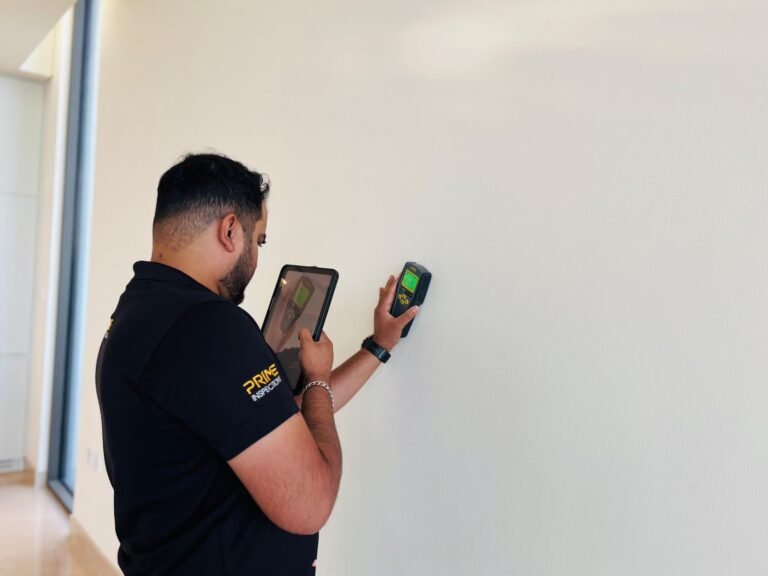
When the camera shows a suspect patch, we confirm it with a moisture meter. If you are not sure what a standard visit covers, here is our note on whether thermal imaging is included in standard snagging.
How the sun can fool the camera
This is called solar loading. A wall that has been in the sun all morning is warm for its own reasons.
From outside, that heat can hide a real problem or create a false one. So we read exterior surfaces early or in shade, and we prefer interior imaging during the hot hours.
The report records the time and conditions of each reading.
Why the afternoon helps on west-facing rooms
By late afternoon the west wall has taken the full sun. Hot air finds its way through gaps in window frame packing and insulation.
Inside, the camera picks this up as a warm strip along the frame. In the morning, the same gap is often faint or invisible.
That is why we like to check west-facing rooms after 3pm when we can.
Why do AC tests in summer need hours, not minutes?
A short AC test is the most common shortcut we see at handover, and the one that misses the most.
The ten-minute test problem
Some checklists say a room should cool within ten minutes. Cold air coming out of a grille is a good sign, but it is only one sign.
A condensate drain with poor fall takes time to fill its tray. A gap in duct insulation takes time to sweat. Ten minutes rarely shows either.
What shows up after two to three hours of load
When the AC has run hard for a few hours in July, these are the faults that start to appear:
- Drain tray overflow onto the ceiling
- Condensation on uninsulated chilled water or refrigerant pipes
- Sweating around diffusers
- Insulation gaps at duct joints
- One room much warmer than the rest
- A thermostat wired to the wrong zone
If cooling already feels weak, this guide on how to diagnose an AC that is not cooling before you sign goes further.
Why morning dew matters
Summer mornings in Dubai are humid, with July dew points around 26C. When warm outside air meets glass or metal cooled by the AC, water forms on the outer face.
Owners often think the window is leaking. Usually it is condensation. We record it separately, so a real seal defect does not get mixed up with weather.
If you would like the AC tested under real summer load, a full handover snagging visit covers it.
How does the midday break affect a summer inspection?
Every summer the UAE limits outdoor work in the hottest hours, and it shapes our plan more than people expect.
What the rule says
According to the UAE government guidance on health and safety at work, work in direct sunlight and open places stops between 12:30pm and 3pm, from 15 June to 15 September every year. MOHRE announces the break each year.
Exemptions exist for some urgent work, but snagging is not one of them.
How we plan around it
Our inspectors do not work on roofs, terraces, gardens or external walls during the break.
That window is the best time for indoor AC testing and thermal imaging anyway, so the break simply decides what we do when.
If you attend, please avoid the roof at midday too.
What we found in the Tilal Al Ghaf villa
Back to that July morning.
On the roof and in the garden, Malik found two things that would have been hard to judge at 2pm. There was a gap in the sealant at a parapet coping joint, and a run of hollow tiles on the upper terrace. Tap testing those tiles was easy at seven. By noon the surface would have been too hot to work on properly.
If you want to understand that second finding, we have written about hollow tiles and whether they are a defect.
By 11 Malik was inside. The wet areas were mostly fine, with one shower screen seal noted.
Through the middle of the day the AC had been running for over twelve hours, and the outside was close to 40 degrees. Thermal imaging showed a cool patch on a ceiling below a ducted AC unit, which pointed to a duct insulation gap.
It also showed a warm strip along the head of a west-facing window frame in the master bedroom. By the afternoon, with the sun on that west wall, the strip was impossible to miss.
Our Engineering Manager, Mohammed Nadeem Maldar, has one habit he asks every inspector to keep: “We put the time on every thermal photo. A reading without the hour and the conditions is only half a finding.”
Villa vs apartment: does the plan change?
Yes, quite a lot. The difference is mostly about what is outside.
Apartments
There is no roof to walk, so the early start matters less. Balcony checks and facade-facing windows still go best in the morning.
A typical apartment takes 2 to 4 hours. A late morning start works well, as long as the AC has been on in every room since the night before.
Villas and townhouses
Roofs, terraces, gardens, pool decks, external AC units and boundary walls all sit outside. That makes an early start strongly better.
Villas take longer, so in summer we plan most of a day around the hours. If your villa handover falls in July or August, it is worth asking for an early start when you book.
Frequently Asked Questions
Is summer a good time for a snagging inspection in Dubai?
Yes, for many checks it is the best season. The AC runs under full load and the gap between indoor and outdoor temperature is large, so cooling faults and thermal findings show clearly. Roofs, terraces and gardens simply need to be done early in the day, before the surfaces get too hot.
What time should a summer snagging inspection start?
For villas and townhouses, the best time of day to snag is an early start, around 7am, so the roof, terraces and garden are checked before the sun is high. Apartments can start later in the morning, as long as the AC has been running in every room since the night before.
Does the midday break stop snagging inspections?
The UAE midday break stops outdoor work in direct sun from 12:30pm to 3pm between 15 June and 15 September. We do not work on roofs, terraces or gardens in that window. Indoor checks continue, and that is often the best time for AC testing and thermal imaging.
Does thermal imaging work better in summer?
Indoors, usually yes. Published thermography guidance looks for an indoor to outdoor difference of about 10 degrees Celsius held for a few hours, which a Dubai summer with the AC on easily gives. Outside walls in direct sun can mislead the camera, so we read those early or in shade.
Should the AC be on before the inspector arrives?
Yes. Ask the developer or building team to switch the AC on in every room the evening before, with internal doors open. That gives the system hours of load before testing and builds the temperature difference thermal imaging needs to show anything useful on walls and ceilings.
Why are my windows wet on the outside in the morning?
On humid summer mornings, warm outside air meets glass cooled by the AC, and moisture condenses on the outer face. It is usually condensation, not a leak. We record it separately in the report so it does not get mixed up with a real window seal defect.
How long does a villa snagging take in summer?
A typical apartment takes 2 to 4 hours. Villas take longer because of roofs, terraces, gardens and external units, so in summer we plan most of a day and split the work by hour: outside first, then inside through the hottest part, then west-facing rooms late in the afternoon.
Should I attend a summer snagging inspection in person?
It helps, but it is not required. If you come, the first hour and the last hour are the most useful, when we walk the outside and then go through findings together. Please avoid the roof at midday. Many owners follow remotely and read the report instead.
Ask for an early slot and we will plan the hours
The Tilal Al Ghaf report reached the owner within 24 hours, with the hour each photo was taken, so the developer could see the conditions. The developer re-sealed the coping joint and re-fixed the window frame packing. The duct insulation was corrected after a second look.
The owner told Malik the early start had cost him nothing except an alarm. We share it because the afternoon slot would have caught some of it, not all of it.
If your handover falls between June and September, ask the developer for the earliest slot they have, or send us their options. We will plan the hours, test under real summer load with our 250+ checkpoint checklist, and send the report within 24 to 48 hours. We inspect and report; we do not do the repairs.
Handover snagging starts from AED 999 for a studio or one bedroom and from AED 3,999 for a villa, excluding VAT. Our RERA certified team works from Business Bay and has completed 73,000+ inspections. When you are ready, you can book a summer snagging slot planned around the heat.