How to Plan Snagging Around DEWA Activation and AC Commissioning
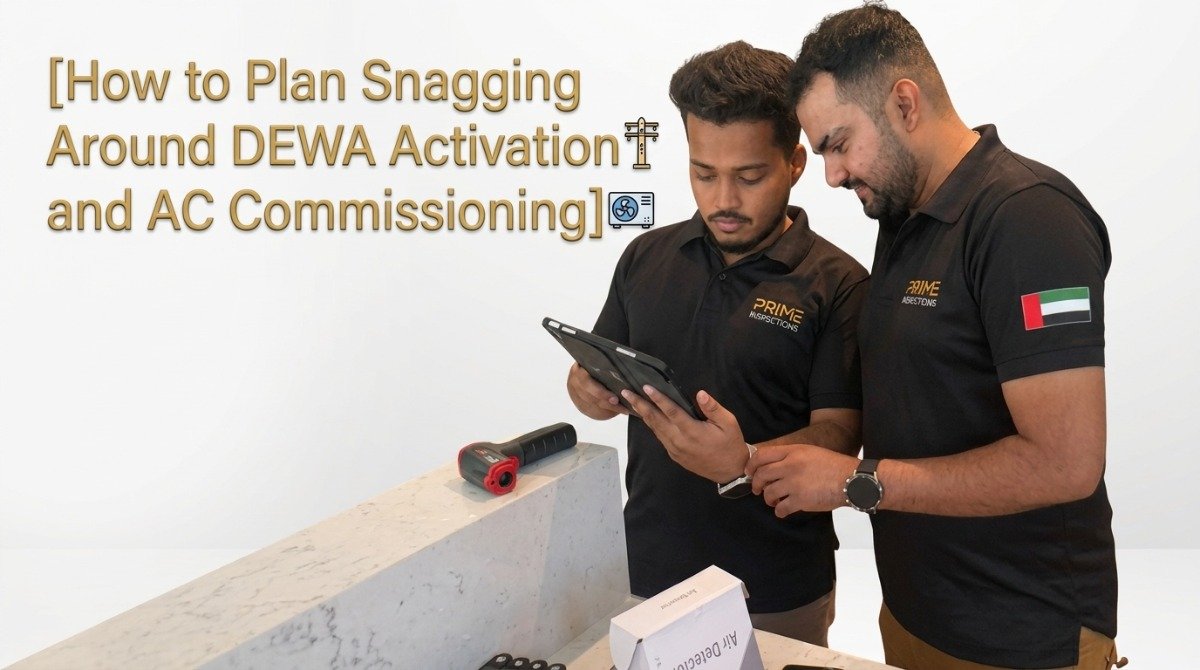
It was 7:40 on a Tuesday morning in September when Farhan rang the bell of a two bedroom apartment in a Sobha Hartland tower on Empower district cooling.
The owner had flown in from abroad. Before we started, he asked one thing: “DEWA activation came through last night. Can we test everything today?”
Farhan checked the fan coil grille in the living room. Air was moving. It was not cold.
The DEWA meter was live, but the chilled water account had never been registered. That small gap decided how the rest of his week went.
Most of the trouble we see at handover is not the defects. It is the order things were done in.
The short answer: book your snagging inspection for the day after DEWA activation and district cooling activation are both confirmed, not before. Without power, water and chilled water, roughly a third of a handover inspection cannot be done, including AC, thermal scanning, water pressure and drainage. Ask the developer for the meter release date early and register cooling in parallel.
Why does the order of DEWA, cooling and snagging matter?
A large part of a snagging inspection is performance testing. Those tests need live utilities. In a dead unit, the inspector can look, but cannot measure.
What an inspector cannot test in a dead unit
Without power and water, these checks either cannot run or lose most of their value:
- AC performance in every room
- Water pressure and flow at each outlet
- Drainage under real flow
- The water heater
- Sockets, lighting circuits and the RCD trip test
- Extract fans in bathrooms and the kitchen
- Thermal scanning of walls and ceilings
Together that is about a third of the scope. We have written separately about what happens when DEWA is not connected on inspection day. This article is about the step before that: planning so it does not happen.
Why a dry unit can look perfect
A concealed pipe joint shows nothing until water runs through it. A condensate line with no fall looks fine until the AC produces water.
Thermal scanning reads temperature differences, not water. In a dry, unpowered unit, there is nothing for the camera to read.
We have seen units that looked flawless dry show a weeping joint once water ran for twenty minutes.
What is the difference between DEWA activation and district cooling activation?
This is where first-time owners get caught. DEWA activation gives you electricity and water. District cooling activation gives you the chilled water that makes the AC cold. One does not switch on the other.
DEWA activation for a new owner
DEWA (Dubai Electricity and Water Authority) handles move-in for owners. You apply online or through the DEWA app with your title deed or Oqood and your Emirates ID.
If a tenant is moving in, an Ejari registration usually passes their details to DEWA through the One Step Move-in service.
Guides published in 2026 list a refundable security deposit of AED 2,000 for an apartment and AED 4,000 for a villa, plus a small activation fee. Once approved, connection usually follows within about a day.
Figures change, so check the current amount with DEWA before you pay.
District cooling is a separate account
Many Dubai towers buy chilled water from a district cooling provider. The main providers in Dubai and the wider UAE include Empower, Emicool and Tabreed.
The idea behind district cooling is simple: a central plant chills water and pipes it to many buildings.
At handover, air moving through the fan coil means DEWA is live. Cold air means chilled water is live.
Each provider asks for its own documents. Empower asks owners and tenants for proof of ownership or an Ejari contract, plus Emirates ID and passport. Emicool asks owners for a master developer NOC or the new title deed, and says registration takes about two business days once documents are complete.
Deposits differ too. Empower’s published residential deposit has been listed at AED 2,000 for an apartment and AED 3,000 for a villa, plus one-time connection and admin charges. Emicool links its deposit to the capacity charge. Please confirm the exact figure with your provider.
How to tell which system your unit has
Look in your SPA or the developer’s handover pack for the words “chiller” or “district cooling”.
Fan coil units in the ceiling and no outdoor condenser on the balcony usually point to chilled water. Many villas use ducted split or DX systems instead. In that case, DEWA activation alone is enough for the AC.
What is the right sequence before a handover inspection?
This is the order we suggest before handover. Each step depends on the one before it.
- Settle the developer’s final statement and service charges. Developers usually do not release the DEWA meter or issue an NOC until final dues are cleared.
- Ask the developer, in writing, when the meter will be released to you. An email with a date beats a phone call. Keep the reply.
- Apply for DEWA activation the same day the meter is released. Have your title deed or Oqood and Emirates ID ready beforehand.
- Register with the cooling provider in parallel, not after. Keep the title deed or Oqood, Emirates ID, passport and, for Emicool, the developer NOC ready.
- Wait for both confirmations, then book the inspection for the next morning. Send the confirmation SMS or email to your inspector.
- Ask the building team to open the chilled water valves to your unit and switch the AC on early. Have your access pass and any NOC the building needs ready too.
- Attend in person or remotely, and do not sign acceptance until the full report is in. If you feel pressure to accept keys before the report is ready, you can ask for time politely and in writing.
If you are flying in for a short trip, the DEWA activation and cooling dates decide whether one visit is enough.
How many days should you allow? A simple planning calendar
Counting back from the handover appointment, this is roughly how it plays out on our jobs.
| Day (from handover appointment) | What you do | Who it depends on | What can go wrong |
| 21 to 14 days before | Receive the handover notice, read the final statement, ask for the meter release date in writing | Developer | Statement arrives late or with unexpected charges |
| 14 to 7 days before | Pay final dues, get developer NOC or clearance, collect access pass details | You and developer | Payment clears slowly, NOC delayed |
| 7 to 4 days before | Apply for DEWA activation once the meter is released; register cooling the same day | DEWA, cooling provider | Missing document, meter not yet transferred |
| 3 to 1 days before | Confirmations arrive; book the inspection; ask the building team to open valves | You, building team | Valves left closed, AC not switched on |
| Inspection day | AC on from early morning, inspector arrives, full scope tested | Inspector | None, if the steps above are done |
| 1 to 2 days after | Report arrives in 24 to 48 hours; submit it to the developer | You | Signing acceptance before reading it |
These are planning windows from our jobs, not official deadlines. Developers and providers each set their own timings.
If you already have your activation date, send it to us and we will book handover snagging for the morning after.
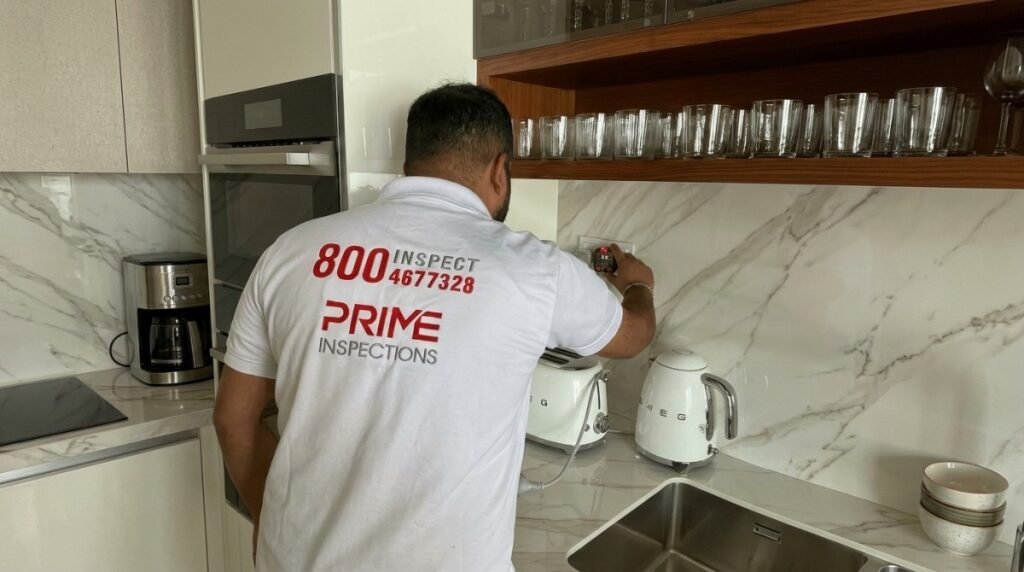
What does AC commissioning at handover actually involve?
AC commissioning is the contractor’s job of setting up and proving the system. Our part is to check it independently, under real load. A unit that blows cool air for ten minutes has not been tested. It has been switched on.
How long the AC should run before testing
We ask for the AC to run in every room, on a cool setting, for at least two to three hours before we arrive.
Published thermography guidance looks for an indoor to outdoor difference of about 10 degrees Celsius, held for at least three hours, before a thermal reading is reliable. In a Dubai summer with the AC on, that is easy. With the AC off, it never happens.
What we measure room by room
In each room, we record:
- Supply air temperature at the grille
- Return air temperature
- The difference between the two
- Thermostat response and fan speeds
- Noise and vibration
- Signs that chilled water reaches the fan coil unit (FCU), such as pipe temperature and condensation on the valve body
- Condensate drain flow and fall
- The FCU drain tray and the access panel size
Developers do not publish an acceptance number for these readings, so we record them and compare rooms. A room much warmer than the rest gets flagged.
If the air already feels weak, this guide on how to diagnose an AC that is not cooling before you sign goes into more detail.
Defects that only show under load
Some faults stay hidden until the system has worked for a while:
- A condensate line with no fall, so the tray slowly fills
- Tray overflow onto the ceiling board
- Condensation on uninsulated chilled water pipes
- Insulation gaps at duct joints
- Sweating around diffusers
- A thermostat wired to the wrong room
Humid summer air makes all of these show faster, as long as chilled water is there.
What happened in the Sobha Hartland apartment
Back to that September morning.
Farhan did what could be done properly: the visual scope, electrical tests, doors, tiles and joinery. He labelled the report partial, with “AC and thermal deferred” stated clearly on it.
His DEWA activation was done; the missing piece was cooling. He registered with Empower the same day. Two days later, chilled water reached the unit, and we went back.
This time the AC had been running for close to three hours. The living room and second bedroom read normally. The master bedroom did not.
Its condensate line had almost no fall. The drain tray filled, and a faint damp ring formed on the gypsum ceiling near the access panel.
The thermal scan showed the cold patch spreading before it was visible to the eye. The moisture meter confirmed it.
None of this would have appeared on the first morning.
Our Engineering Manager, Mohammed Nadeem Maldar, puts it simply: “We will not write ‘AC tested’ on a report when chilled water never reached the unit. Air moving through a grille tells you the fan works, nothing more.”
If your building is on district cooling, it helps to tell us the provider when you book.
Does waiting for keys give you more defects liability time?
Some owners think collecting the keys later starts the defects liability period later. In Dubai, that is not quite how it works.
Under Article 40(b) of Dubai Law No. 6 of 2019, the developer is responsible for defects in mechanical, electrical, sanitary and sewerage installations for one year from the date the unit is handed over. If the owner delays taking possession, that period starts from the date of the completion certificate instead.
So waiting does not add time. It can take time away. Structural defects are separate: Article 40(a) sets ten years from the completion certificate.
Your SPA may also set its own terms, so check it and assume the earlier date applies. Speak to a lawyer for your specific contract.
Frequently Asked Questions
Do I need DEWA connected before a snagging inspection?
We strongly recommend it. Without DEWA activation, we cannot test sockets, lighting, water pressure, drainage, the water heater or extract fans, and thermal scanning loses most of its value. A visual inspection is still possible, but the report must be labelled partial and a second visit booked for the deferred tests.
How long does DEWA activation take for a new property?
Once DEWA approves a move-in application, connection usually follows within about a day. In our experience the real delay comes earlier, while waiting for the developer to release the meter after final payments. Ask for the meter release date in writing as soon as your handover notice arrives, and keep the reply.
What is the DEWA deposit for an apartment and a villa?
Guides published in 2026 list a refundable DEWA security deposit of AED 2,000 for an apartment and AED 4,000 for a villa, plus a small activation fee. Amounts can change, so check the current figure with DEWA before you pay. The deposit is refundable when you close the account later.
Is chiller activation separate from DEWA activation?
Yes. In buildings on district cooling, chilled water comes from a separate provider such as Empower, Emicool or Tabreed, with its own registration, documents and deposit. DEWA powers the fan inside the fan coil unit. Only the cooling provider sends the chilled water that actually makes the air cold.
Can you test the AC without chilled water?
Only partly. We can check that fans run, grilles are fitted and thermostats respond. We cannot measure cooling, check condensate drains under load or run meaningful thermal scanning. We will not mark the AC as tested on a report until chilled water reaches the unit and the system has run for a few hours.
How long should the AC run before the inspection?
We ask for the AC to run in every room for at least two to three hours before we arrive. Published thermography guidance looks for a steady indoor to outdoor temperature difference of about 10 degrees Celsius for several hours before thermal readings can be trusted.
What if the developer has not released the meter by inspection day?
If you can, move the inspection. If the snagging window will close first, we inspect what can be inspected, label the report partial and list every deferred test. You then submit it within the window and ask the developer to acknowledge it in writing. Avoid signing acceptance on a partial report.
Does a second visit cost extra if utilities were not ready?
A return visit to complete deferred tests is booked as a separate visit, so please ask for the fee when you book. The simplest way to avoid it is to share your DEWA activation and chilled water confirmation dates with us before choosing the inspection day.
Book the inspection for the morning after activation
In the Sobha Hartland apartment, the owner sent the full report to the developer before signing acceptance. The developer’s team re-laid the drain line and replaced the stained ceiling board. Our re-inspection found it dry under load.
He did not lose money. He did lose a day of his trip, and he told Farhan he would have booked differently if he had known the order. That is the reason for this article.
If your handover notice has arrived, the most useful thing you can do this week is ask for the meter release date. Once DEWA activation and chilled water are confirmed, send us the date and Farhan or Malik will book the next morning.
We test, we measure, and we report within 24 to 48 hours, using our 250+ checkpoint checklist. We do not do the repairs, so the report has no reason to soften anything.
Handover snagging starts from AED 999 for a studio or one bedroom and from AED 3,999 for a villa, excluding VAT. Our RERA certified team in Business Bay has carried out 73,000+ inspections. When you are ready, you can book your handover snagging for the day after DEWA and chilled water go live.