Cracks in a New Dubai Villa: How to Tell Cosmetic From Structural

A five bedroom villa handover in a Dubai Hills Estate community. The owner had walked the whole ground floor without saying much, then stopped in a bedroom doorway and ran a fingernail along a hairline crack above the door head. Thin, dry, maybe a hand span long.
“That is normal,” the handover representative said. “Every villa does that.”
He was mostly right, and that is exactly what makes this situation difficult. Most cracks in a new Dubai villa are harmless. The problem is that “most” is doing a lot of work in that sentence, and nobody in the room had tested which kind this one was. This is one of the villa crack calls we get most often at Prime Inspections.
We measured it, photographed it against a scale, logged the elevation and marked both ends. Eleven minutes of work. That crack turned out to be plaster shrinkage and it never moved again.
The point was never the crack. The point was that from that afternoon onward, it was on record.
The short answer
Most cracks in new Dubai villas are shrinkage cracks in plaster and screed, and they are cosmetic. Treat a crack as a structural concern if it runs diagonally from a door or window opening, steps through blockwork mortar joints, passes through the full thickness of an element, or widens over time.
Everything else in this article is the method for telling those two groups apart, and the reason why doing it inside your defects period matters more than the crack itself.
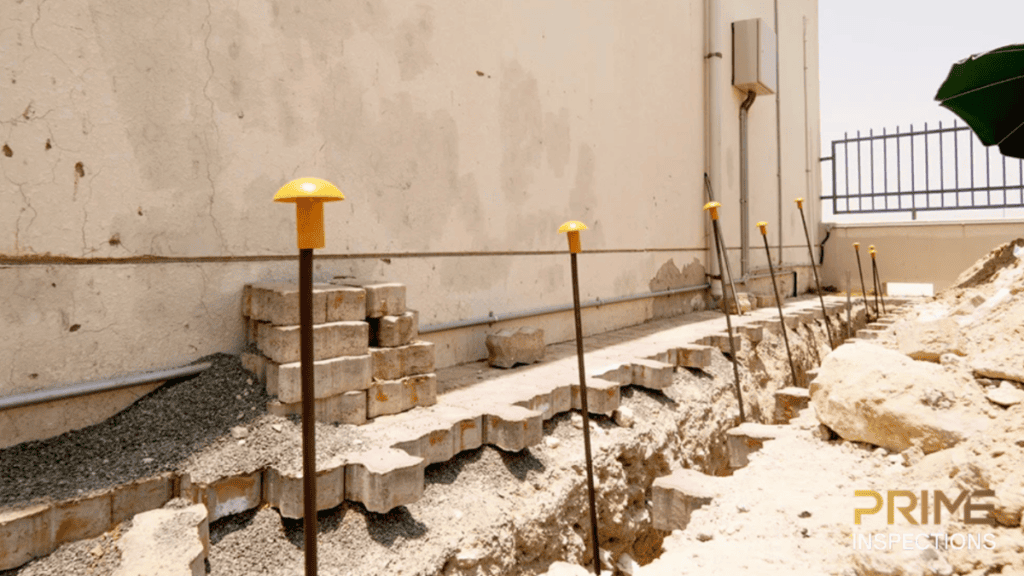
The three families of crack, and the triage that separates them
Cracks get lumped together in most articles you will read. In practice they belong to distinct families, and the family determines the verdict.
Shrinkage cracks in plaster and screed
Cement based plaster and floor screed lose water as they cure. As they lose water they contract slightly, and when the contraction exceeds what the material can take, it cracks.
Appearance: fine, often hairline, usually straight or gently wandering, confined to the finish layer. Typical timing is the first six to twelve months after the finishing works.
Verdict: cosmetic. It is still a snag while you are inside the defects period, because the developer’s finishing scope, the same scope covered under our New Handover Snagging inspections, includes leaving you a sound surface.
Crazing or map cracking
A dense network of very fine cracks across a surface, like a dried riverbed. Caused by surface shrinkage in the top layer of plaster or render, often from over troweling, an over rich mix, or drying too fast in heat.
We inspected a Tilal Al Ghaf townhouse where dozens of these had appeared across a freshly plastered stairwell wall in exactly that map pattern. The owner assumed the wall behind it was failing. Nothing was moving anywhere. Crazing across a single material, with no displacement and no continuation into the blockwork behind, is a finish defect. The fix is preparation and plaster, not structure.
Verdict: cosmetic, but it needs proper re-preparation rather than a skim coat over the top, or it will telegraph back through.
Gypsum board joint cracking at taped seams
Straight, unusually neat cracks running along ceiling or partition lines, tracing where two boards meet. That neatness is the giveaway. Nature does not crack in perfectly straight metre long lines.
Cause is usually taped joint movement, insufficient jointing compound, or board movement from framing that was not fixed tightly.
Verdict: cosmetic finishing defect.
Thermal movement cracks
Dubai puts building materials through a hard cycle. Exterior surfaces bake through the day and cool at night, and different materials expand at different rates. Cracks show up where two materials meet, at parapets, along external wall junctions, and around large openings on hot elevations, including around pool decks and coping, where we also carry out dedicated pool inspections.
Appearance: often at material interfaces, sometimes opening and closing seasonally.
Verdict: usually cosmetic, but it needs the right repair detail, because filling a moving joint with rigid filler guarantees a return visit.
Settlement cracks
Ground beneath a building consolidates in the years after construction, and if it does so unevenly, the structure above responds. In blockwork this shows as stepped cracking, following the mortar joints in a staircase pattern.
We inspected a District One villa where a diagonal stepped crack ran from the corner of a window opening down through the blockwork, and only on one elevation. The other three walls were clean. That asymmetry is significant. Openings are the weak point in a wall, and movement finds them first.
A crack that follows mortar joints in steps and concentrates at an opening is movement, not drying. It gets monitored, not filled.
Verdict: needs assessment and monitoring. Most settlement is minor and stops. Some does not, and you only learn which by measuring over time.
Structural cracks
The smallest group and the one everything else is written to identify. Covered in its own section below, because it deserves the space.
The diagnostic tests an engineer uses
Villa inspections by our About Us team of InterNACHI-certified engineers take us four to eight hours as part of our Complete Building Inspection work, and this is a large part of why. A crack you can see in ten seconds takes considerably longer to classify honestly.
Width measurement, and why width alone is not the answer
Everybody wants a number. “Anything over 2mm is structural” is the kind of rule that circulates, and it is not reliable. A 3mm shrinkage crack in screed can be meaningless. A 0.5mm crack through a structural element with an offset between the two faces is not.
There is no crack width published in UAE law that decides this for you. Width is one input. We record it against a scale in every photograph so it can be compared later, and that comparison is worth far more than the first reading.
Pattern and direction
Vertical cracks in the middle of a wall panel usually point to shrinkage. Diagonal cracks running from the corners of openings point to movement. Stepped cracks following mortar joints through blockwork point to differential movement in the wall or below it.
Horizontal cracks along a mortar bed course are less common and get looked at more carefully.
Does the crack cross different materials
This is the test most homeowners never hear about, and it separates the two groups faster than anything else.
Shrinkage happens within a material as it dries. So a shrinkage crack tends to stay inside the plaster, or inside the screed, and stop where that material stops.
When a crack runs from plaster into the blockwork behind it, or continues across a junction between two different materials without deviating, something is moving the elements themselves. Drying does not do that.
Is it progressive
A crack that is not growing is a very different problem from one that is. We fit a crack gauge, sometimes called a telltale, across the crack. It is a simple calibrated device that shows movement in millimetres, and it is read at set intervals over weeks.
Alongside that we take dated photographs with a scale in frame, from the same position each time. Two readings four weeks apart tell you more than any single opinion on day one.
Is moisture present
We run a moisture meter across and around the crack, and thermal imaging over the surrounding area as part of our Water Leakage Inspection service. Water changes the diagnosis completely.
A crack with a moisture signature behind it may be a water ingress path rather than a movement issue, similar to what we see in cases like damp appearing on a ceiling, and that has its own consequences for reinforcement, finishes and mould. On external walls and wet area partitions we check this as standard.
Not sure whether it is drying or moving? Speak to our engineer on +971 50 602 1830, or WhatsApp for an instant quote.
When a crack is a structural matter
We work only for homeowners, never for developers or real estate agents. That matters most right here, because the standard reply to any crack question is that it is settlement and it is normal. Sometimes that is a considered engineering judgement. Sometimes it is a script. You cannot tell the difference from the sentence alone, only from the evidence.
These are the signs that move a crack out of the cosmetic conversation.
Through thickness. The crack appears in the same place on both faces of the same element. It is not a finish that has cracked. The element has cracked.
Displacement or offset. The two sides of the crack are no longer in the same plane. Run a finger across it and you feel a step. That means the two halves have moved relative to each other, and movement of that kind does not come from plaster drying.
Location on a structural element. Cracks at or near columns, beams, and slab soffits carry more weight than cracks in a partition wall, because those elements carry the building. A crack at a slab soffit near a beam gets treated seriously until proven otherwise.
Associated symptoms. Doors and window frames going out of square, doors that no longer latch, visible deflection in a slab or beam, floors that have developed a slope. When a crack arrives with company, the company is often the more informative part.
We inspected a Bluewaters Island unit where a crack ran through the full thickness of an element close to a beam, and showed a small but consistent offset between the two faces. Through thickness plus displacement is the point where the conversation stops being cosmetic and becomes an engineering assessment.
That is also the point where the law changes. Structural defects that threaten the stability and safety of the building are decennial territory, which is a very different clock from your defects period.
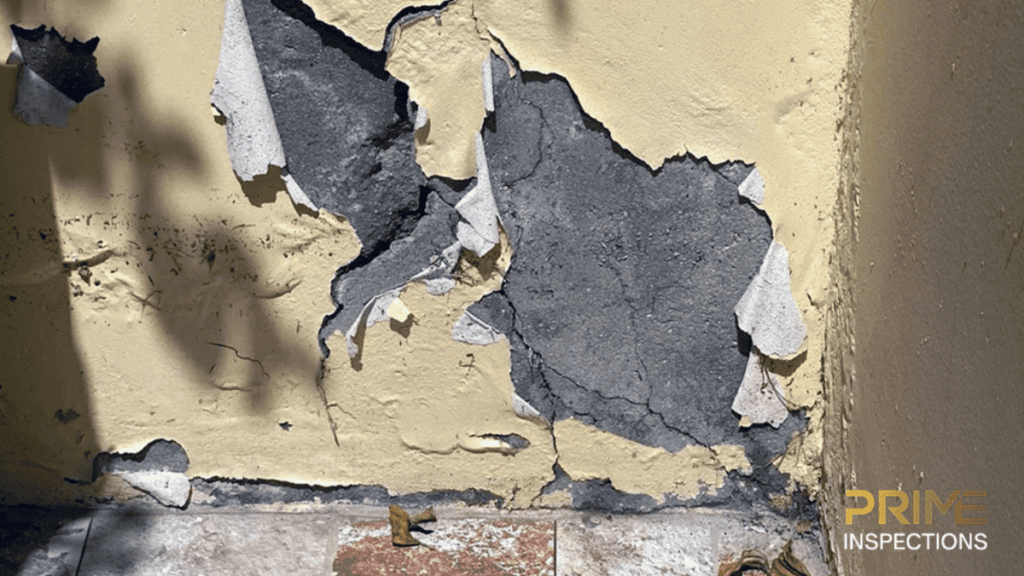
The law: DLP versus decennial liability in the UAE
Two protections run in parallel and they are constantly confused. They come from different places, cover different things, and expire at very different times.
| Protection | Length | Source | Covers | Can it be excluded |
|---|---|---|---|---|
| Defects Liability Period, general finishing | Commonly 12 months | Contractual, set by your SPA | Finishing defects including cosmetic cracks, plaster, paint, joinery | Yes, terms vary by SPA |
| MEP warranty | Commonly 12 months | Contractual and market practice | Mechanical, electrical and plumbing | Yes, terms vary by SPA |
| Decennial liability | 10 years from handover of works | Statutory, Article 821 | Total or partial collapse, and defects threatening structural stability and safety | No |
The DLP is not set by law. It comes from your sale and purchase agreement, and the wording is worth reading properly rather than assuming twelve months.
Decennial liability is different. It sits in Federal Decree-Law No. 25 of 2025, which repealed Federal Law No. 5 of 1985 and came into force on 1 June 2026. The relevant provisions are Articles 821 to 824. If you find older articles citing Article 880 of the 1985 law, they are quoting a repealed instrument, which tells you something about how current those pages are.
Three things worth knowing about it:
Article 821 makes the contractor and the supervising engineer jointly liable for ten years for total or partial collapse and for defects threatening the stability and safety of the building. It is strict liability, which means you are not required to prove negligence. You establish the defect and the liability follows.
Article 823 voids any contractual clause that tries to exclude or limit that liability. A clause in your SPA saying otherwise does not survive.
Article 824 gives you three years from the collapse or from the discovery of the defect to bring the claim. Discovery starts a clock, so a crack you noticed two years ago and never documented is a weaker position than one photographed on the day.
Two practical consequences. First, signing your handover acceptance form does not remove decennial liability. Second, comfort and finish issues sit under the contract, not under Article 821, so for the large majority of cracks your instrument is the DLP and your evidence needs to land inside it.
Our villa inspections run four to eight hours and produce a photo based digital report within 24 hours, with severity scoring and a developer ready rectification checklist. View our free sample report.
Normal versus defect: a crack triage table
| What you see | Likely family | Urgency | Responsible | Action |
|---|---|---|---|---|
| Hairline crack above a door or window, in plaster only | Shrinkage | Low | Developer, within DLP | Photograph, log, submit as a snag |
| Fine network across a plastered wall | Crazing | Low | Developer, within DLP | Snag for re-preparation, not a skim over |
| Straight crack tracing a ceiling board line | Taped joint | Low | Developer, within DLP | Snag as a finishing defect |
| Crack at a junction between two materials, seasonal | Thermal movement | Low to medium | Developer, within DLP | Snag with the correct flexible repair detail |
| Diagonal stepped crack through blockwork at an opening | Settlement | Medium | Developer, assessment needed | Monitor with a crack gauge, do not fill |
| Same crack visible on both faces of an element | Structural | High | Contractor and supervising engineer | Engineering assessment now |
| Crack with a felt step or offset between faces | Structural | High | Contractor and supervising engineer | Engineering assessment now |
| Crack at a slab soffit, column or beam | Structural until proven otherwise | High | Contractor and supervising engineer | Engineering assessment now |
| Crack plus doors out of square or visible deflection | Structural | High | Contractor and supervising engineer | Engineering assessment now |
What to do step by step
- Photograph the crack with a scale in frame, a steel rule or tape, and make sure the date is on the file.
- Mark both ends of the crack with a fine pencil line and date those marks on the wall.
- Log the room, the elevation and the height, so the same crack can be found again without hunting.
- Photograph the full wall as well as the close up, so the crack has context in the record.
- Check the same location on the opposite face of the wall, and photograph what you find or do not find.
- Remeasure at set intervals, four weeks apart is a reasonable rhythm, from the same camera position.
- Do not fill, skim or paint anything before it is recorded. A filled crack cannot be classified.
- Book an inspection while you are inside your defects period, not after it lapses.
- Submit a written, dated notice to the developer referencing your SPA defect clause, with the photographs attached.
That list is deliberately mundane, and it is the whole difference between a snag that gets fixed and a dispute that goes nowhere.
What to do if the developer fills and paints it
A crack that is filled and painted looks solved. Whether it is solved depends entirely on whether anyone addressed why it cracked.
A cosmetic cover up treats the visible line. A root cause repair deals with the movement, the moisture path or the workmanship failure that produced the line, then makes good the finish. From two metres away, on the day, they are identical.
Which is why reappearance is such useful evidence. A crack that comes back after repair is telling you the source was never resolved, and that is far harder for anyone to argue with than the original crack was.
We attended a villa where the same crack had been filled and painted twice inside the defects period and returned both times. The owner had photographs of every stage with dates, and that record settled the matter without a fight. Without it, each reappearance would have been treated as a fresh, minor, first time complaint.
So when a repair is done, verify it. We run de-snag visits with dated comparison photographs taken from the original camera positions, and the same approach applies when checking a contractor’s own remedial work through our Contractor Work Inspection service, which is the only way to prove a repair held rather than assume it.
Escalation when the developer refuses
Most crack snags resolve at the first or second step. If a developer stalls or goes quiet on you, see our guide on what to do when a developer ignores your snag list. Otherwise the ladder looks like this.
- Written, dated notice. Email the developer’s customer care or handover team with the photographs, measurements, room references and the relevant SPA defect clause. Keep everything in one email thread so the timeline speaks for itself.
- Customer care, then head of customer experience. In writing, referencing your original notice date. Escalating within the developer is not a formality, it is where a lot of stalled cases actually move.
- RERA or the Dubai Land Department. File through the Dubai REST app or the Dubai Land Department website. The fee is commonly cited at AED 1,000 per complaint, with an initial response in about five working days and a decision target near 60 days. Verify the current fee before filing and treat the timelines as targets rather than guarantees. RERA, the Real Estate Regulatory Agency, sits within the DLD. The DLD call centre is 800 4488.
- Dubai Municipality. For genuine building code or structural safety concerns, Dubai Municipality is the appropriate authority rather than a real estate regulator.
- Dubai Courts. The last route. Claims above AED 100,000 generally require a report from a DLD registered property consultant, commonly in the region of AED 5,000 to AED 15,000. Dubai Courts filing fees are percentage based with a cap commonly cited around AED 40,000. Timelines are typically six to eighteen months. Verify all of these figures before relying on them.
One correction worth making plainly, because it costs people weeks: the Rental Disputes Centre does not hear buyer versus developer defect disputes. It handles landlord and tenant matters only.
“The report was well structured and accepted by the developer without arguments.” That is a client review, and it describes the actual objective at this stage. You are not trying to win an argument. You are trying to remove the room for one.
What it costs
Villa and townhouse inspection fees in Dubai are quoted by built up area and complexity. As a broad market range, expect roughly AED 2,000 to AED 3,500 for a smaller townhouse, and AED 3,500 upward for larger villas, with figures rising for very large or multi storey properties and where a de-snag revisit is included. Treat these as market ranges only and request a quote for your property. If you are buying rather than building, the same crack triage applies to a Resale Property Inspection too.
Weigh that against the alternative routes. A standalone structural consultant report costs more and usually arrives without the full property context. The court route brings a DLD registered consultant fee of roughly AED 5,000 to AED 15,000 before you count anything else.
On timing, developer rectification of documented snags commonly runs around four to five weeks in this market from written notice to completion. That is our field observation, not a legal deadline, and your SPA may say something different.
Your snagging window is also SPA dependent. Many contracts allow a defined period from handover notice to inspect and submit snags, and it is often shorter than owners expect. Read yours rather than assuming.
If you are overseas
A large share of Dubai villa owners are not in the country, and cracks are one of the easier things to handle remotely if you set it up in advance.
Issue a power of attorney or a simple authorisation letter naming your representative, so they can attend, receive keys and grant access. Coordinate access with the handover team before the inspection date rather than on it, since villa access often needs community security clearance.
Ask for a live video walkthrough so you see the cracks and the measurements as they are recorded. Then read the digital report in full, including the severity scoring, and raise questions before you respond to the developer.
One rule we do not soften: never authorise signing of the handover acceptance form remotely before you have read the report. Decennial liability survives that signature, but your finishing and defects position does not survive it nearly as well.
Frequently asked questions
Are cracks normal in a new build villa? Yes, in the sense that most new villas develop some. Plaster and screed shrink as they cure, and fine cracks are a common result. Normal does not mean acceptable though. Within your defects period these are still snags the developer should make good.
What is the difference between shrinkage cracks and structural cracks? Shrinkage cracks form inside a single material as it dries, stay in the finish layer, and stop moving. Structural cracks pass through the full thickness of an element, often show a step or offset between the two faces, and tend to grow. Location and behaviour separate them, not width.
How wide does a crack have to be to be serious? There is no width published in UAE law that decides this. A wide shrinkage crack in screed can be harmless while a narrow through thickness crack with displacement is not. What matters is whether the crack passes through the element, whether the faces have moved, and whether it is growing.
What are settlement cracks and do they stop? Settlement cracks come from ground beneath the building consolidating unevenly. In blockwork they appear as stepped diagonal cracks following mortar joints, usually near openings. Most minor settlement stabilises within the first years. The only way to know whether yours has is measured monitoring over weeks.
Are diagonal cracks above doors dangerous? Not automatically, but they earn a closer look. Openings concentrate stress, so movement shows there first. A short hairline diagonal in plaster only is usually shrinkage. A stepped diagonal continuing through the blockwork, on one elevation, is movement and should be monitored.
What is decennial liability in the UAE? It is a ten year statutory liability under Article 821 of Federal Decree-Law No. 25 of 2025, previously Article 880 of Federal Law No. 5 of 1985. It makes the contractor and supervising engineer jointly liable for collapse and for defects threatening the stability and safety of the building.
How long is the developer responsible for structural defects in Dubai? Ten years from handover of the works for structural stability and safety, under Article 821. That period is statutory and Article 823 voids any contract clause attempting to exclude or limit it. Non structural defects sit under your SPA defects period instead, which is usually far shorter.
Who fixes cracks after the Defects Liability Period ends? Cosmetic and finishing cracks become the owner’s cost once the contractual DLP has expired. Cracks that qualify as structural remain covered by decennial liability for the full ten years, and Article 824 allows three years from discovery of the defect to bring a claim.
Can a developer refuse to repair cracks by calling them cosmetic? They can assert it, and often the assertion is correct. But cosmetic is a conclusion that follows a test, not an assumption you accept. Measured photographs, a crack gauge record and a severity scored report turn the discussion from opinion into documented findings.
Should I fill and paint a crack myself? Not before it is recorded. Filling destroys the evidence of what the crack was doing and makes classification impossible afterwards. Photograph it with a scale and a date, mark the ends, get it assessed, then repair. Doing it in that order costs you nothing and protects your position.
How do inspectors monitor whether a crack is growing? We fit a crack gauge or telltale across the crack, which shows movement in millimetres, and read it at set intervals over weeks. Alongside that we take dated photographs with a scale from a fixed camera position, and record moisture readings where water may be involved.
What if I already signed the handover form? Decennial liability under Article 821 is unaffected by your signature and cannot be excluded under Article 823. Your contractual defects position is weaker, but a dated written notice with photographic evidence still carries weight, particularly if the defects period has not yet expired.
Where we carry out these inspections
Villa crack triage is something we do across most of Dubai’s master-planned villa communities, including Emirates Hills, Palm Jumeirah, Jumeirah Bay Island and Dubai Creek Harbour, alongside Dubai Hills Estate, District One, Tilal Al Ghaf and Bluewaters Island covered above. You can read more on the same themes in our Home Inspection and Snagging blog categories.
Book an inspection
If a crack has appeared in your villa, the useful thing to do this week is not to decide what it is. It is to get it measured, photographed against a scale, severity scored and dated, so that whatever it turns out to be, you have a record from the day you found it.
Our villa inspections run four to eight hours, carried out by InterNACHI certified, RERA certified inspectors, and produce a photo based digital report within 24 hours with a developer ready rectification checklist. We work only for homeowners, never for developers or real estate agents, and we cover Dubai and the wider UAE. Browse more posts on our blog or read our Privacy Policy and Terms of Service for how we handle your booking and data.
Book an inspection now on +971 50 602 1830, or WhatsApp for an instant quote, and get the crack recorded while the developer is still contractually on the hook.