What to Do When Your Balcony Door Will Not Seal in Dubai
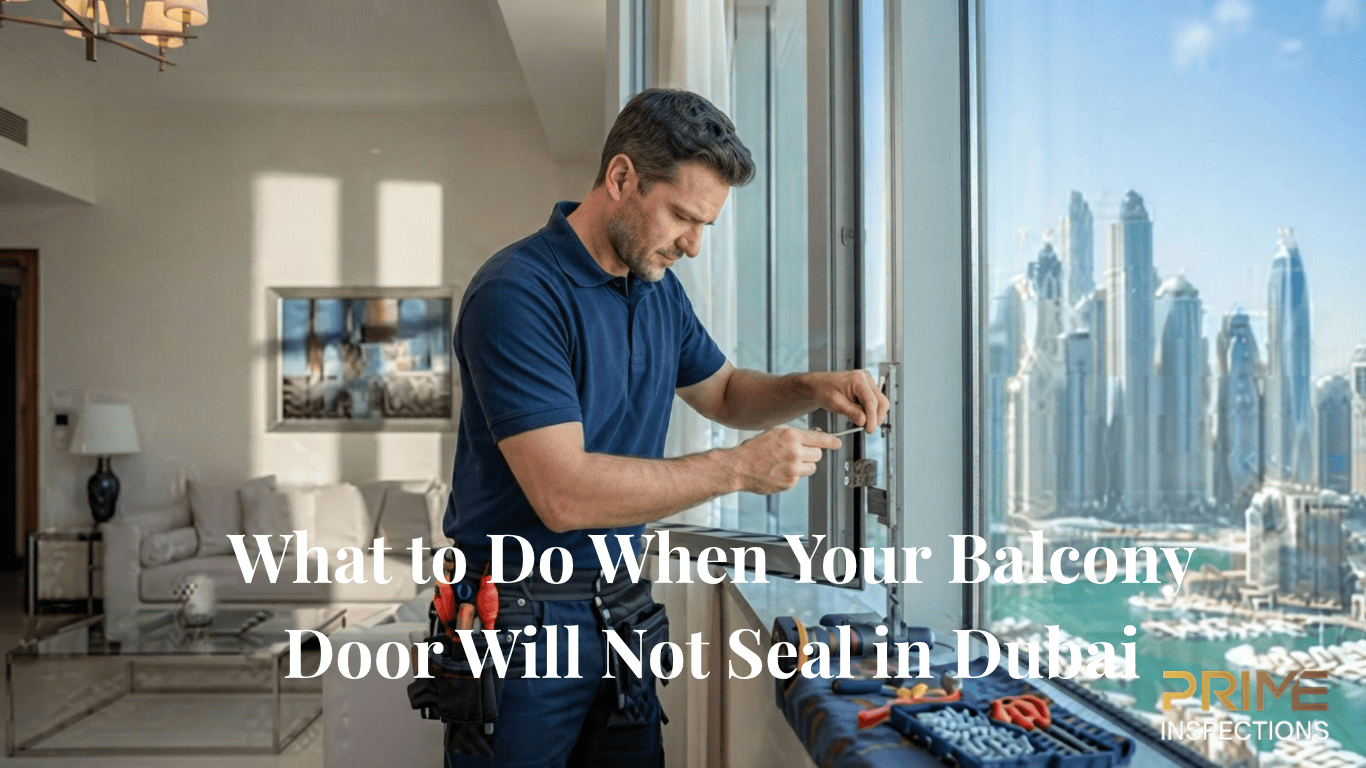
A high floor two bedroom in a waterfront tower in Dubai Creek Harbour, August. Three weeks after handover, the owner had started noticing a fine grey line of dust along the sliding track every single morning, and a faint whistle when the wind came off the water at night. This is one of the calls we get most often at Prime Inspections.
He had mentioned it once. The answer was that the door was just stiff and needed to bed in.
Doors do not bed in. Compression is set by hardware and geometry, and neither of those improves by itself over time.
A door that does not seal is an envelope defect, not a comfort preference. And you can prove it tonight with a sheet of paper and a torch.
We work only for homeowners, never for developers or real estate agents, as our About Us page sets out. We also do not install, adjust or supply doors, so there is nothing at the fix end of this for us to sell you.
Direct answer: how to confirm the door is not sealing
Close the door on a sheet of paper and pull it. If it slides out with no resistance, the door is not compressing the seal at that point. Repeat every 200 to 300 mm around the full perimeter, then confirm at night with a torch shone from the balcony side into a dark room.
Mark every failure point on a quick sketch of the door as you go. The pattern of failures is more informative than any single one.
We ran this on a slider in Bluewaters Island where the paper pulled free with no resistance along the entire latch side, while the hinge side gripped properly. That pattern pointed straight at compression at the locking points rather than at the seal itself, which was intact.
Test the whole perimeter, because the pattern names the fault.
The four field tests, step by step
Each test answers a different question. Run them in this order.
1. The paper drag test
What it tells you: where the door is not compressing the seal.
- Take an A4 sheet, ordinary weight.
- Open the door, place the paper across the seal line, close and lock the door fully.
- Pull the paper straight out.
- Repeat every 200 to 300 mm around the entire perimeter, including the threshold, the head and both jambs.
- Mark each position on a sketch as pass, weak or free.
Reading it: firm resistance is a pass. Free with no drag is a fail. Weak drag is worth noting, since a marginal seal today gets worse.
Limitation: it tells you about compression, not about water.

2. The torch or light test at night
What it tells you: where daylight and therefore air can pass.
- Wait until dark and turn off all the lights in the room.
- Have someone stand on the balcony with a bright torch.
- They run the beam slowly around the closed door perimeter from outside while you watch from inside.
- Photograph any light you see, and note its position.
Reading it: a continuous thin line of light along an edge usually means a geometry problem, a leaf not parallel to the frame. Light at discrete points, particularly at corners and at locking points, usually means seal or hardware.
Limitation: a seal can be compromised without passing visible light.
3. The smoke pencil test
What it tells you: actual air movement, including leaks that pass no light.
- Choose a windy day, or run the AC to create a pressure difference across the door.
- Hold a smoke pencil or an incense stick close to the closed perimeter.
- Move slowly around the full edge and watch the smoke stream.
- Deflection or pull means air is moving through.
Limitation: it needs a pressure difference to work, so a still day with the AC off gives you nothing.
4. The hose test
What it tells you: whether water can cross the threshold.
- Use a gentle flow, never a jet. A jet proves nothing except that pressurised water beats most seals.
- Start low at the threshold and work upwards, spending a minute or two at each level.
- Have someone watching inside with a torch on the floor line.
- Time the first appearance of water and photograph it.
Limitation: this is a water ingress test only. It says nothing about air or dust sealing, and a door that passes the hose test can still be failing the paper test badly. This is the same discipline behind our Water Leakage Inspection service.
Reading the results together
| What you found | Likely cause |
|---|---|
| Paper free along one whole edge, light in a continuous line | Frame racked or leaf out of square |
| Paper free only near the lock, hinge side firm | Multipoint lock not adjusted for compression |
| Paper free at corners only, light at corner points | Missing or shrunken corner seals |
| Smoke moves but no light visible | Worn or compressed weatherstrip, brush seal |
| Water crosses the threshold, air tests mostly fine | Track drainage or threshold detail, not the seal |
| Sand present but paper test passes everywhere | Check track drainage slots and the corner junctions |
Found a light line or a sand line? Send us a photo on WhatsApp and an engineer will tell you whether it is a seal, the frame or the lock.
What is actually failing: seals, geometry or hardware
This is the section that separates a real fix from an adjustment that lasts three weeks.
Seal faults
- Weatherstrip failed, missing, permanently compressed or shrunken back from the corners
- Brush or pile seals worn flat on a heavy sliding leaf
- Threshold seal worn or never fitted
- Missing corner seals at track junctions, one of the most common omissions we find
- Gasket pulled away at the corners
These are the cheapest to fix and the ones everyone reaches for first.
Geometry faults
- Frame racked or out of square during installation
- Wrong packers or shims at install, so the frame is not true
- Hinge sag on a heavy leaf, so the door drops and no longer meets the frame evenly
- Warped leaf
- Uneven reveal, wider on one side than the other
We attended a large slider in Jumeirah Bay Island that had been fitted with new brush seals twice and still leaked air and dust. The frame was out of square and the interlock never fully met, so no seal was ever going to close that gap.
Replacing a seal on a racked frame just buys new seals.
Hardware faults
- Multipoint lock not engaging fully, or not adjusted to draw the leaf into compression
- Keeps and striker plates out of position
- Roller height set wrong on a slider, so the leaf sits high or low and misses the interlock
- Interlock and meeting stile misalignment on a two panel slider
Track and drainage faults
- Drainage slots in the track blocked with construction debris, or never opened at all
- No upstand at the threshold
- Threshold weep holes blocked with silicone or grout
The same drainage principle applies to pool deck doors and enclosures, which we check under our dedicated Pool Inspection service.
Which faults an adjustment can fix
Adjustable on site: roller height, multipoint lock engagement, keep and striker positions, hinge adjustment within range, seal replacement, clearing drainage slots.
Not adjustable, needs reinstallation or replacement: racked or out of square frames, warped leaves, wrong packing at install, missing threshold upstand.
If the developer’s answer to a geometry fault is a fresh seal, you will be back on this page in a month.
Why this matters more in Dubai than anywhere else
A gap that would be a mild annoyance elsewhere behaves differently here.
Fine sand and the sand line
Gulf sand is fine enough to pass a partial seal that would stop coarser dust. During a shamal event, wind driven sand finds every opening in the perimeter.
Which makes the sand line a free diagnostic. Where sand collects on the sill and in the track tells you which part of the perimeter is open, and photographing it after a wind event costs you nothing.
We inspected a unit in Tilal Al Ghaf where the sand line stopped abruptly about a third of the way along the sill. It matched exactly to a corner seal that had never been installed at the track junction.
Sand deposits map the open part of the perimeter for free.
Dust and the cleaning burden
A slow, continuous dust ingress is what a tenant complains about in month one, and it is the kind of complaint that gets repeated because it never resolves. Landlords tend to meet this problem through their tenant rather than directly. We see the same pattern on villa terrace doors in communities like Dubai Hills Estate, not just on tower balconies.
External noise
Roads, marinas, event venues and nearby construction. A light line is usually a noise line, because the same gap that passes light passes sound. If the room is noisier than you expected, run the light test before assuming it is the glazing.
Driven rain
Dubai rain is infrequent but intense, and often arrives with strong wind. A door can pass every dry month and then fail on a single storm night.
We saw exactly that on Palm Jumeirah. A door that had been perfectly dry for months let water across the threshold during the first serious storm, because the track drainage slots were blocked and the track was holding water above the upstand level, the same pattern that shows up in cases like damp appearing on a ceiling.
A track that cannot drain becomes a reservoir, and wind driven rain finds it.
Cooling load
At ambient above 45 C the temperature difference across your envelope is large, so continuous air infiltration works against your fan coil or split system throughout the day, not just occasionally.
We are deliberately not putting a percentage on that. No verified UAE figure exists for a given door gap, and anyone quoting one to you has made it up. The mechanism is real and the direction is obvious. The magnitude depends on your specific unit.
Is a gap a defect or a tolerance?
The fear behind this question is usually about looking fussy. It should not be.
In our practice, these are defects:
- Visible daylight around a closed and locked leaf
- Paper pulling free with no resistance at any point on the perimeter
- An audible whistle in wind
- Sand or water crossing the threshold
- A lock that will not throw fully
These are usually cosmetic:
- Reveal gaps that are uneven side to side but fully sealed
- Minor finish marks on frames or ironmongery
- Slight variation in gasket colour or seating that still compresses
Be clear about the basis. Developer acceptance thresholds for door gaps are not published in Dubai, so this is engineering practice rather than regulation. Anyone quoting you a legal maximum gap is inventing it.
For severity triage, a door admitting water is Category A, safety and water ingress. A door admitting dust and air is Category B, functional. Neither of those is Category C, and raising it as a cosmetic complaint is what gets it treated as one.
We test every external door and openable window, score it by severity, and give you a developer ready rectification checklist.
How we test it during a snagging inspection
- Perimeter paper testing on every external door and openable window, not just the balcony slider
- Light testing where conditions allow, and smoke where a pressure difference exists
- Thermal imaging for infiltration signatures, which read clearly when there is a large temperature differential across the envelope
- Laser distance measure to check reveal squareness top, middle and bottom
- Operation cycle testing of every lock, roller, hinge and closer
- Photographs labelled by room and elevation so each finding is locatable
All of it feeds a 250 plus point inspection as part of our Complete Building Inspection work, with severity scoring, a developer ready rectification checklist and a photo based digital report inside 24 hours. Inspections are carried out by InterNACHI certified, RERA certified inspectors.
How to raise it, and what to do if the developer refuses
Snag it before you sign, and log it as part of your snag list. The Defects Liability Period clock and your acceptance of the unit’s condition attach to the handover acceptance signature, not to key collection. A door seal defect recorded before that signature is in a materially better position than one raised afterwards.
Your snagging window is set by your SPA, commonly quoted as seven to fourteen days. That is a contractual term, not a published legal period, so read your own clause.
If the developer stalls, see our guide on what to do when a developer ignores your snag list.
- Written dated notice. To the developer or main contractor, with your test results, the marked perimeter sketch, photographs of light lines and sand lines, and reference to the SPA defect clause.
- Customer care, then head of customer experience. In writing, one thread.
- RERA and the Dubai Land Department. Via the Dubai REST app or the Dubai Land Department website. The fee is commonly cited at AED 1,000 per complaint, with an initial response in about five working days, admission roughly seven to fifteen days once documents are complete, and a decision target near 60 days. RERA sits within the DLD. Verify current figures and treat the timings as targets.
- Dubai Courts. Claims above AED 100,000 generally require a DLD registered property consultant. Dubai Courts is the final route.
The Rental Disputes Centre handles landlord and tenant disputes only and does not hear buyer versus developer defect claims. For genuine building code or structural safety concerns, Dubai Municipality is the relevant authority rather than a real estate regulator.
On liability, be accurate. An ordinary balcony door seal defect is a contractual DLP item under your SPA, not a statutory warranty. A facade or envelope failure threatening structural stability and safety is a different matter and falls under Article 821 of Federal Decree-Law No. 25 of 2025, previously Article 880 of Federal Law No. 5 of 1985, for ten years, with Article 823 voiding exclusion clauses and Article 824 requiring a claim within three years of discovery.
If you are overseas
Issue a written authorisation letter so your inspector and representative can attend. Join by live video walkthrough, which works particularly well for this defect since the paper and light tests are highly visible on camera. Take the digital report, submit it yourself, and arrange remote de-snag verification afterwards through our Contractor Work Inspection service. Do not authorise signing of the handover acceptance form before you have read the report.
What it costs
Inspection ranges by unit type, as market ranges only, request a quote:
| Property | Market range |
|---|---|
| Studio or 1 bedroom | AED 800 to AED 1,200 |
| 2 bedroom | AED 1,200 to AED 1,800 |
| 3 bedroom | AED 1,800 to AED 2,500 |
| Townhouse | AED 2,500 to AED 3,500 |
| Villa | AED 3,500 to AED 6,000 and above |
The same test protocol applies whether you are at a new handover or checking a resale purchase through our Resale Property Inspection service.
Inside the defects period the repair itself should cost you nothing. That is the entire point of getting it documented while the obligation still sits with the developer.
Rectification commonly runs around four to five weeks in this market from written notice. Field observation, not a legal deadline.
Frequently asked questions
Why does dust come in through my balcony door? Because the door is not compressing its seal somewhere on the perimeter. Gulf sand is fine enough to pass a partial seal, so a gap too small to notice visually still admits dust daily. Run the paper drag test around the full perimeter to locate it.
Is a gap around a balcony door a snag? Visible daylight around a closed and locked leaf is a defect, as is paper pulling free with no resistance, an audible whistle, or sand or water crossing the threshold. Uneven but fully sealed reveal gaps are usually cosmetic. Developer acceptance thresholds are not published, so this is engineering practice.
How do I test if my door is sealing? Four tests. Paper drag around the perimeter for compression, a torch from the balcony into a dark room for light paths, a smoke pencil on a windy day or with the AC running for air movement, and a gentle hose from low to high for water. Each answers a different question.
Why is there sand on my window sill after a sandstorm? Because wind driven sand found an opening in the door or window perimeter. The useful part is where it sits. A sand line that stops abruptly along the sill usually marks the end of the open section, often a missing corner seal at a track junction.
Why does my balcony door whistle in the wind? Air is being forced through a narrow gap under pressure. It generally means a small but continuous opening rather than a large one, commonly at a locking point or where a gasket has pulled back from a corner. The light test usually finds it.
Can a bad door seal increase my cooling bill? The mechanism is real, since continuous infiltration at over 45 C ambient works against your cooling system all day. We will not quote a percentage, because no verified UAE figure exists for a given gap size and the magnitude depends entirely on your unit and exposure.
Why is my sliding door hard to open? Usually roller height or condition, track debris, or a frame that is not square. Worth noting that a stiff door and a leaking door are often the same fault, since both point at geometry. An adjustment that makes it slide easily without restoring compression has not fixed the seal.
Does water come in through balcony doors in Dubai rain? It can, particularly during wind driven storms. The most common mechanism is blocked track drainage slots, which turn the track into a reservoir until water rises above the threshold upstand. A door that has been dry for months can fail on one storm night.
Where we carry out these inspections
Door and window seal testing is something we run across Dubai’s apartment towers and villa communities, including District One and Emirates Hills, alongside Dubai Creek Harbour, Bluewaters Island, Jumeirah Bay Island, Tilal Al Ghaf and Palm Jumeirah covered above. Read more in our Home Inspection and Snagging blog categories.
The engineer’s verdict
Door seal defects are cheap and quick while the developer’s contractor is still on site, and expensive and argumentative once the snagging window closes.
This is the item owners regret leaving off the list more than any other, because the symptoms arrive slowly. The dust builds up over weeks. The noise you get used to. The cooling cost never itemises itself. By the time the pattern is obvious, the easy window has passed.
Take the paper and the torch to the door tonight. It costs nothing and it takes ten minutes.
Clients rate us 4.9 out of 5 across 108 Google reviews, and the line that fits this page is: “No switch was left unswitched, lock left unchecked or tile untapped.”
Get an engineer led inspection before you accept keys or release final payment. Certified. Experienced. Trusted. Speak to our engineer on +971 50 602 1830, or view our free sample report. Browse more on our blog, or read our Privacy Policy and Terms of Service for how we handle your booking and data.