Drainage Odours in a New Dubai Unit: The Diagnostic That Finds the Real Cause
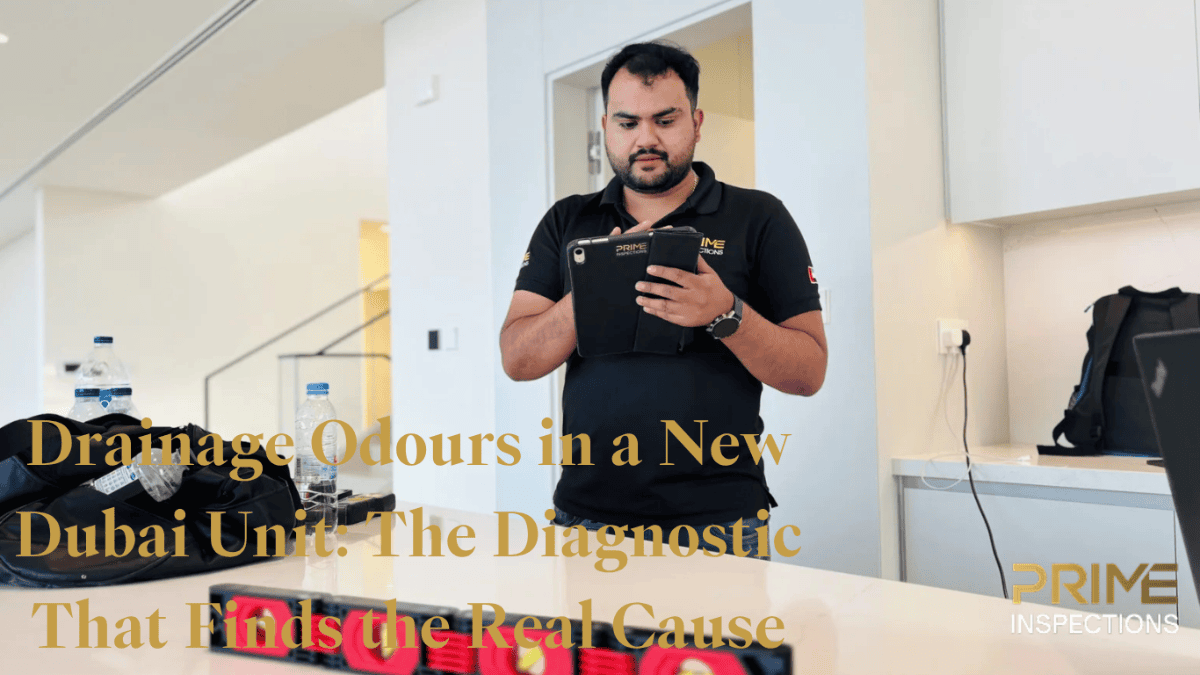
A July handover in a new tower. The unit had been sealed and empty since completion, and the owner opened the guest bathroom door, took half a step in, and came straight back out. This is one of the calls we get most often at Prime Inspections.
The handover representative did what everyone does. He filled a jug at the basin, poured it down the shower drain, and within a few minutes the smell had faded. Problem solved, was the implication. Just needs using.
We let the owner enjoy that for about thirty seconds before saying the honest thing. That test proved almost nothing.
Pouring water down a drain will always kill the smell temporarily, whatever the cause. The information you actually need does not arrive on handover day. It arrives four days later, when you find out whether the smell stayed away.
It came back on the fourth day. And the reason it came back is the whole subject of this article.
The short answer
Refill every trap in the unit, including floor traps and the laundry, write down the date, then wait. If the drainage smell stays away, it was evaporation from a dry P trap. If it returns within days, you have a venting or seal defect, and it belongs on your snag list.
That single test separates a maintenance non issue from a construction defect, and it costs you nothing but a week of patience. Almost nobody runs it, which is why so many owners end up refilling drains every month for a year without ever asking why.
How a water seal actually works, and why new Dubai units lose it
Every fixture that drains has a trap. Under a basin or a sink it is usually a P trap, a bend in the pipe that holds a small volume of standing water. That water is the seal. Waste flows through it, and sewer gas from the drainage system below cannot pass back up through it.
Bathrooms and balconies also have floor traps, the grated drain in the floor. Same principle, different shape. The chamber under the grating holds water, and that water is what stands between your bathroom and the soil stack.
A water seal only works while the water is there. Take the water away and the trap becomes an open pipe.
In Dubai, water leaves traps faster than most people expect. Ambient heat is high, indoor humidity under continuous air conditioning is low, and a fixture that is never used gets no top up. Add the fact that most new units sit vacant for weeks or months between completion and move in, and you have close to ideal conditions for a trap to dry out quietly.
We handed over a vacant one bedroom in a tower not unlike Dubai Creek Harbour in midsummer where every single trap in the unit had gone dry. Basin, shower, both floor traps, the kitchen sink. We refilled all of them, logged the date, and rechecked the following week. The odour never came back.
That is the clean version of this problem. In a vacant Dubai unit in summer, evaporation is always the first hypothesis. But it is only confirmed when the smell stays away.

The discriminator: evaporation versus a venting or seal defect
Here is the part no competitor page explains properly, and it is the reason people search this question over and over.
On day one, a dry trap from evaporation and a trap being emptied by a defect look exactly the same. Same smell, same location, same instant improvement when you pour water down. You cannot tell them apart by smelling harder or by looking at the fixture.
Time is the only test that separates them.
Evaporation is a one way process. Refill the trap and it stays full for weeks if the fixture is being used, and for a good while even if it is not. If you refill everything and the odour is gone permanently, evaporation was the cause. Nothing is wrong with the plumbing.
A defect refills the problem for you. Refill the trap and something empties it again, and it will keep doing that on a repeating cycle for as long as the defect exists.
The most common mechanism behind that cycle is negative pressure in the soil and waste stack.
A drainage stack needs venting. When a large volume of water discharges down the stack, it drags air with it and creates suction behind it. Proper venting, either a vent pipe running to atmosphere or a correctly specified air admittance valve, lets air in to relieve that suction. Without adequate venting, the stack takes the air it needs from wherever it can find it, and the easiest source is the water sitting in your traps. It pulls the seal out through the trap. That is siphonage.
The symptom pattern is distinctive once you know it:
- The odour returns days after every refill, not weeks.
- It returns at the same fixture or fixtures each time.
- It gets noticeably worse when a large flow discharges, a washing machine emptying, a bath draining, or an upstairs neighbour doing the same.
- You may hear gurgling from a nearby drain when another fixture discharges.
We inspected a two bedroom, a similar unit type to what we see on Bluewaters Island, where the guest bathroom odour came back within a few days of every refill, without fail. The owner had done it four times. What made the diagnosis was the correlation: the smell intensified every time the laundry discharged. That is not evaporation. Water does not evaporate on a schedule tied to your washing machine.
Odour that returns on a cycle, and worsens when a large flow runs, points to negative pressure siphoning the seal. That is a venting defect, and it is a construction issue, not something an occupier can maintain their way out of.
If the smell has already come back once, it is a defect, not maintenance. Speak to our engineer on +971 50 602 1830, or WhatsApp for an instant quote.
The full defect list, fixture by fixture
Once you know the smell is a defect rather than evaporation, the next job is locating it. These are the causes we find, roughly in order of frequency.
Dry P trap under a basin, sink or shower
The straightforward case. Visible under vanities and sinks, hidden for showers. If refilling fixes it permanently, this was it.
Tell tale symptom: odour strongest at one fixture, clears on refill, does not return.
Missing or incorrectly installed floor trap water seal
Floor traps are the ones owners forget, because they look like a drain hole in the floor rather than a plumbing fixture. Some are installed without the seal insert, some with the insert seated wrongly during finishing works, and some are simply the wrong component. In villas and townhouses with private pools, similar floor trap seals protect pool deck drains, which we check as part of our dedicated Pool Inspection service.
Tell tale symptom: odour rising from floor level, strongest near the grating, and the smell returns almost immediately after pouring water in because there is nothing there to hold it.
Unvented or badly vented soil stack
Covered above. This is the one that produces the repeating cycle.
Tell tale symptom: cyclic return correlated with other fixtures discharging, plus gurgling.
Unsealed or uncapped connections behind fittings and under vanities
During fit out, waste connections get opened, capped temporarily, and are supposed to be sealed properly at completion. Sometimes they are not. An open connection behind a boxed in vanity, inside a kitchen cabinet, or behind a fitted appliance vents sewer gas straight into the room, and it is completely invisible unless somebody opens the panel and looks.
Tell tale symptom: constant background odour that is not attached to any one drain, and does not respond to refilling anything.
Missing washing machine standpipe trap
The laundry connection is the single most common omission we find. A washing machine drains into a standpipe, and that standpipe needs its own trap. When it is missing, the machine’s waste hose is inserted straight into an untrapped pipe.
We traced an odour in a unit on Jumeirah Bay Island to exactly this, plus an uncapped connection behind the machine that nobody had touched since installation. A missing trap is a construction omission, not a maintenance issue, and it goes on the snag list as such.
Tell tale symptom: odour in the laundry area or kitchen, worse after a wash cycle.

Uncapped AC condensate drain tied into the waste
Fan coil condensate is often routed into the waste system. If that connection is made without a trap or an appropriate seal, the condensate line becomes an open path between your ceiling void and the drainage system.
Tell tale symptom: odour coming from ceiling level or from the AC diffusers rather than from floor level, sometimes stronger when the AC runs.
Building level sewer gas issues in the common stack
Occasionally the fault is not in your unit at all. A stack vent terminating badly, an issue at a floor below, or a problem in the riser can push odour into multiple units, something we see across larger towers such as those on Palm Jumeirah.
Tell tale symptom: neighbours reporting the same thing, odour on multiple floors, or odour present regardless of what is done inside your apartment. This one changes who is responsible, which is covered further down.
The refill and re-test protocol you can run yourself
You do not need instruments for this stage, and running it before you call anyone makes every conversation afterwards easier.
- Walk the whole unit and count every trap. Kitchen sink, every basin, every shower and bath, every floor trap including balconies and the laundry area, plus the washing machine standpipe.
- Refill each one with a decent volume of water, roughly two litres per trap, and pour it steadily rather than in a splash.
- Write down the date and time, and note which fixtures you refilled. Do not rely on memory.
- Photograph each location, especially any floor trap grating and the laundry connection.
- Keep the unit as close to normally occupied as you can during the test week, since an empty sealed unit changes the conditions.
- Re-check at day two, day four and day seven. Note whether there is any odour, and where.
- If the smell returns, record which fixture it returns at, and whether anything else was discharging at the time.
- Run the washing machine and a bath or shower deliberately, and note whether the odour intensifies during or just after.
Keep the log. Those dates are your evidence, and they are far more persuasive than any description you can give verbally.
That last point deserves emphasis. The single hardest thing about a drainage odour complaint is that it is never present when the person who can authorise the repair is standing in the room. A dated log solves that problem in a way that no amount of insisting can.
What an engineer does that you cannot
Our apartment inspections, carried out by the team described on our About Us page, run two to four hours, and odour diagnosis is one of the reasons. You cannot assess drainage by glancing at fixtures. Every one has to be run, and where a common stack is suspected, the same forensic approach carries through into our Complete Building Inspection work.
Smoke testing. We introduce a non toxic smoke into the drainage line and watch for where it escapes. An uncapped connection behind a vanity or an unsealed floor trap shows itself immediately, which is very difficult to argue with in a report.
Dye testing. Used to confirm flow paths and connections, particularly where an odour comes with an unexplained damp patch.
Hygrometer and environmental readings. Recording humidity and conditions in the unit matters, because it establishes whether evaporation was even plausible for that unit at that time of year.
Access panels and riser checks. We open ceiling access panels, trace the vent route where it is reachable, and photograph what is actually there rather than what the drawings say should be.
Thermal imaging and moisture metering. When odour arrives alongside damp, similar to what we cover in damp appearing on a ceiling, the drainage question and the leak question have to be answered together, which is exactly what our Water Leakage Inspection service is built for.
Photographing behind fitted units. Vanities, kitchen cabinets and appliance recesses hide most of the defects on the list above. We pull panels where we safely can and document what is behind them.
“The exact source of the problem was identified.” That client review line is the deliverable here. Anyone can confirm there is a smell. The value is naming the connection, the trap or the vent that is causing it.
We run every fixture, photograph every trap and connection, and issue a photo based digital report within 24 hours with a developer ready rectification checklist. View our free sample report.
Normal versus defect: an odour triage table
| What you notice | Likely cause | Verdict | Responsible |
|---|---|---|---|
| Smell in a vacant unit, clears after refilling, never returns | Evaporated P trap seal | Not a defect | Owner, routine |
| Smell returns within days of every refill | Siphonage from inadequate venting | Defect | Developer, within DLP |
| Smell intensifies when the washing machine or bath drains | Venting defect in the stack | Defect | Developer, within DLP |
| Smell at floor level, returns almost immediately after refilling | Missing or wrongly seated floor trap seal | Defect | Developer, within DLP |
| Constant background odour, unrelated to any single drain | Uncapped or unsealed connection behind a fitting | Defect | Developer, within DLP |
| Smell in the laundry area, worse after a wash cycle | Missing standpipe trap | Defect | Developer, within DLP |
| Smell from ceiling level or from AC diffusers | Condensate drain connected without a trap | Defect | Developer, within DLP |
| Neighbours on other floors report the same smell | Common stack or vent termination issue | Defect, common property | Owners Association or Management Company |
| Odour with damp staining nearby | Possible leak alongside the odour | Defect, investigate both | Developer, within DLP |
Who is responsible, you or the building
This boundary decides who you send the complaint to, and getting it wrong wastes weeks.
Under Law No. 6 of 2019, jointly owned property in Dubai is split between the private lot, which is your unit, and common property, which is everything shared.
Your private lot generally includes the plumbing inside your unit: fixtures, traps, waste branches serving only your apartment, floor traps, and the wet area works within your boundary. An odour caused by a missing trap under your vanity is a private lot matter, and while you are inside your defects period it is the developer’s to rectify.
Common property generally includes the soil and waste stacks, the risers, the vent pipework serving multiple units, and the structure. An odour caused by a stack vent terminating incorrectly, or a fault in the riser, is common property. That falls to the Owners Association or the appointed Management Company, and it is funded from service charges administered through Mollak, the RERA service charge platform. Where a common stack issue crosses into a genuine building safety concern, Dubai Municipality is the appropriate authority rather than a real estate regulator.
The practical test is simple. If the same odour appears in units above or below yours, or in units on other stacks in the same line, you are almost certainly looking at common property. If it is confined to your apartment and tracks to a specific fixture, it is yours, and inside DLP it is the developer’s obligation.
A word on the developer’s standard reply, which is usually that the unit just needs to be used. We work only for homeowners, never for developers or real estate agents, and that is worth saying here because “just use it” is sometimes correct advice and sometimes a way of running the clock down. The refill log tells you which one you are dealing with, without anyone having to take a position on trust.
Escalation when the developer cannot smell it
If a developer stalls or goes quiet once you’ve raised this, see our guide on what to do when a developer ignores your snag list. Otherwise the ladder looks like this.
- Written, dated notice. Email the developer’s customer care or handover team with your refill log, the photographs, the fixture locations and the correlation notes, referencing your SPA defect clause and the Defects Liability Period. The log is what makes this email different from every other odour complaint they receive.
- Customer care, then head of customer experience. In writing, referencing your first notice date. Keep it in one thread so the timeline is visible at a glance.
- RERA or the Dubai Land Department. File through the Dubai REST app or the Dubai Land Department website. The fee is commonly cited at AED 1,000 per complaint, with an initial response in about five working days and a decision target near 60 days. Verify the current fee and treat those timings as targets rather than guarantees. RERA sits within the DLD and administers Mollak and service charge matters relevant to common property.
- Dubai Courts. The final route, and rarely proportionate for an odour defect. Dubai Courts filing follows the same fee and consultant-report process as any other property defect claim.
Two accuracy points worth stating plainly. First, the Rental Disputes Centre handles landlord and tenant disputes only. It does not hear buyer versus developer defect claims, and people lose weeks discovering that. Second, the defects period covering finishing and MEP, commonly twelve months, comes from your SPA. It is contractual, not statutory, so read your own agreement rather than assuming a standard. Decennial liability under Article 821 of Federal Decree-Law No. 25 of 2025, previously Article 880 of Federal Law No. 5 of 1985, covers structural stability and safety. It is not the route for a drainage odour.
We worked with a landlord who let a unit before the odour was resolved, on the reasonable assumption it would settle once someone was living there. It did not. What had been a developer snag became a tenant complaint, a management problem and an awkward conversation about rent, all at once.
An odour recorded in a dated inspection report before signing is a developer problem. The same odour discovered after the keys are handed over becomes yours to manage.
What it costs
Snagging inspection fees in Dubai are quoted by unit size and complexity. As a broad market range, expect roughly AED 700 to AED 1,500 for a one bedroom apartment and AED 1,200 to AED 2,500 for larger apartments, with villas and townhouses higher again. If you’re buying rather than taking a new handover, the same diagnostic runs through our Resale Property Inspection service. Treat these as market ranges only and request a quote for your unit.
Set that against the alternative. A plumbing callout treats the symptom, and each visit is another fee, while the defects period quietly runs down in the background. The inspection route produces documentation that transfers the cost of the actual repair to the party contractually responsible for it, and where a contractor’s remedial fix needs verifying afterwards, that’s the same job as our Contractor Work Inspection service.
On timing, developer rectification of documented snags commonly runs around four to five weeks in this market from written notice to completion. That is our field observation, not a legal deadline, and your SPA may specify something different.
Your snagging window is SPA dependent too. Many agreements allow a defined period, often in the region of seven to fourteen days from handover notice, to inspect and submit snags. Check yours.
If you are overseas or letting the unit
Drainage odour is the defect that suffers most from remote ownership, because the test needs someone physically present on days two, four and seven.
Issue a power of attorney or an authorisation letter naming your representative so they can attend, receive keys and grant access. Coordinate building access in advance rather than on the day.
Nominate a proxy to run the refill protocol, and give them the numbered list above with instructions to photograph and timestamp every step. A handover agent, a property manager or a trusted contact can do this. What matters is that the dates are recorded by whoever is in the room.
Ask for a live video walkthrough during the inspection so you see the floor traps lifted and the connections photographed, not just described.
And do not authorise signing of the handover acceptance form remotely before you have read the report. If you are letting the unit, resolve the odour before the tenancy starts. Once a tenant is in place, the same defect costs you a great deal more than a snag entry would have.
Frequently asked questions
Why does my brand new apartment smell like sewage? Most often because the water seals in the traps have evaporated while the unit sat empty, leaving an open path from the drainage system into the room. Less often, a trap is missing, a connection was left uncapped, or the soil stack is inadequately vented. The refill test tells you which.
What is a P trap and how does it stop smells? A P trap is a bend in the waste pipe under a fixture that permanently holds a small volume of water. Waste passes through, but the standing water blocks gas from travelling back up the pipe into the room. It works only while the water is there.
Why does the drain smell come back after I pour water down it? Because something is emptying the trap again. Usually negative pressure in a badly vented soil stack siphons the water out when a large flow discharges. Evaporation does not repeat on a cycle of days. A returning odour is a venting or seal defect, not maintenance.
What is a floor trap and does every Dubai bathroom have one? A floor trap is the grated drain set into the bathroom or balcony floor, with a chamber beneath that holds a water seal. They are standard in Dubai bathrooms and common on balconies and in laundry areas. They are also the traps owners most often forget to refill.
Can a badly vented soil stack cause smells? Yes, and it is the leading cause of odour that keeps coming back. Without adequate venting, a discharging stack pulls air from the nearest available source, which is the water in your traps. Once the seal is siphoned out, sewer gas passes freely into the room.
Is sewer gas in an apartment dangerous? It should not be present in a home, and persistent ingress means the drainage system is not sealed as designed. Beyond the obvious nuisance, treat it as a defect that needs resolving rather than tolerating. If anyone in the household feels unwell, seek medical advice rather than guidance from an article.
Why does the smell get worse when I run the shower or washing machine? Because a large discharge creates suction in the stack. If venting is inadequate, that suction pulls the water out of nearby traps, and the odour follows immediately. This correlation is one of the clearest indicators of a venting defect, so record it when it happens.
Does the AC condensate drain cause bad smells? It can. Fan coil condensate is often routed into the waste system, and if that connection lacks a trap or a proper seal, odour travels back through it into the ceiling void and out at the diffusers. The tell is a smell that seems to come from above rather than from any drain.
Is a drainage smell covered by the Defects Liability Period? Usually yes, as part of the plumbing scope, provided the cause is a defect rather than an empty trap in a unit nobody has used. The length and wording come from your SPA rather than from law, so check the actual clause and submit inside the window.
Who is responsible if the smell comes from the building stack, the owner or the Owners Association? Common property, including soil and waste stacks, risers and shared vent pipework, falls to the Owners Association or Management Company under Law No. 6 of 2019. Plumbing inside your private lot is yours, and within the defects period it is the developer’s to rectify.
How do inspectors test for drainage defects? We run every fixture, refill and check every trap including floor traps, use smoke testing to reveal escape points, dye testing to confirm flow paths, and thermal imaging with moisture metering where damp is present. Access panels are opened and connections behind fitted units are photographed.
Can I fix a dry trap myself? Refilling a trap, yes, and you should. What you cannot do as an occupier is install a missing standpipe trap, seat a floor trap seal correctly, cap an open connection behind fitted joinery, or correct stack venting. Those are construction defects and they belong on a snag list.
Where we carry out these inspections
Drainage odour diagnosis is something we run across Dubai’s apartment towers and villa communities alike, including Dubai Hills Estate, District One, Emirates Hills and Tilal Al Ghaf, alongside Bluewaters Island, Dubai Creek Harbour, Jumeirah Bay Island and Palm Jumeirah covered above. You can read more on related themes in our Home Inspection and Snagging blog categories.
Book an inspection
If the smell in your new unit has already come back once after refilling, you are not dealing with a drying trap. You are dealing with a defect, and the useful move is to get it located and documented while the developer is still contractually responsible for it.
Our apartment inspections run two to four hours, carried out by InterNACHI certified, RERA certified inspectors, with every fixture run, every trap checked and every connection photographed. You receive a photo based digital report within 24 hours with a developer ready rectification checklist. We work only for homeowners, never for developers or real estate agents, across Dubai and the wider UAE. Browse more posts on our blog, or read our Privacy Policy and Terms of Service for how we handle your booking and data.
Book an inspection now on +971 50 602 1830, or WhatsApp for an instant quote, and get the odour documented before you sign the handover acceptance form or hand keys to a tenant.