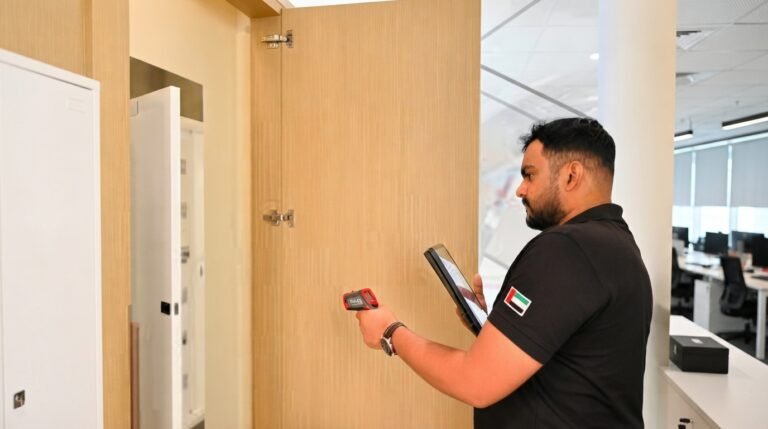
How to Sequence Snagging, Re-Inspection and Key Acceptance
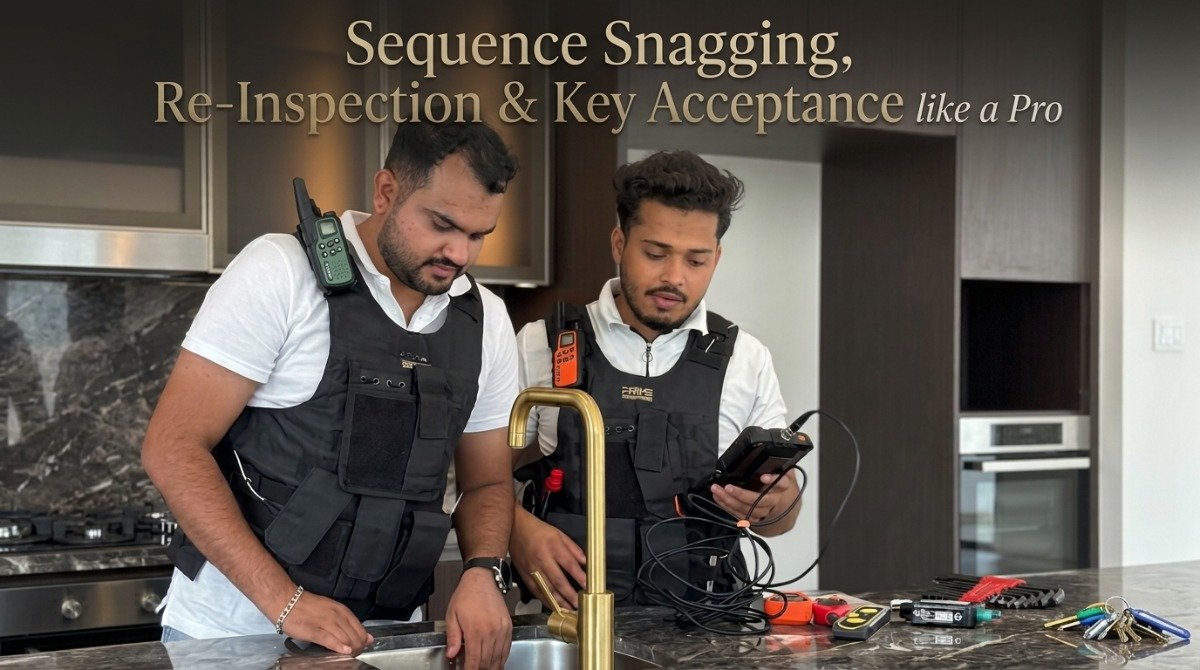
It was 7:50 on a Monday morning in March, outside a four bedroom villa in DAMAC Lagoons. The developer had asked the owner to collect the keys that Thursday.
Our inspector Malik started on the roof before the sun got strong. Then he worked down through the bedrooms, the kitchen and the garden.
By early afternoon the list had grown long. Roof drainage. Two bathroom floors with poor falls. A pool pump leaking at the union. Cracked tiles on the terrace.
The owner walked the garden with Malik and asked the question behind every snagging re-inspection we do: “Do I take the keys on Thursday and trust the list, or do I wait until it is all fixed?”
The safest order is snag, submit, sign with a written list or defer, let the developer repair, then do a snagging re-inspection before keys or before closing items. Book the first inspection before signing, log every item with dates on the handover form, and treat nothing as closed until it has been physically re-checked.
There is no single right order for every developer. But there is a safer one. Below we set out the sequence, the two acceptance paths, and what a snagging re-inspection before keys actually checks.
At Prime Inspections & Snagging we inspect and report. We do not repair, and we do not give legal advice, so please read the legal points as general guidance.
Why the Order Matters at Handover
Handover feels like one event. In practice it is a chain of small steps, and the order of those steps decides how strong your record is.
What changes once you sign
The handover form acknowledges that you have taken possession. Signing it does not remove your right to report installation defects later.
What it does change is proof. Once you live in the home, a scratch or a chipped tile is harder to attribute to the build. Items written on the form before you sign are much easier to follow up.
What does not change
Under Article 40(b) of Dubai Law No. 6 of 2019, the developer stays responsible for defective installations for one year from handover. Under Article 40(a), structural parts are covered for ten years from the completion certificate.
So signing is not the end of your rights. Our guide to the defects liability period in Dubai explains both periods in more detail.
The Step-by-Step Sequence
Here is the order we usually suggest. It works for apartments and villas, with small changes for each developer’s process.
| Step | What happens | Who acts | What to keep |
| 1. Handover notice | Book the inspector, confirm utilities and access | Owner | Notice email, booking confirmation |
| 2. Snagging inspection | 250+ checkpoint inspection before signing | Inspector | Report within 24 to 48 hours |
| 3. Submit the snag list | One numbered list through the developer’s official channel | Owner | Reference number |
| 4. Acceptance decision | Path A, sign with the list attached, or Path B, defer | Owner with developer | Signed handover form with list and dates |
| 5. Developer repairs | Contractor works through the list | Developer | Developer’s completion notice |
| 6. Snagging re-inspection | Item by item check: fixed, partly fixed, not fixed, new item | Inspector | Re-inspection report |
| 7. Close or repeat | Close fixed items in writing, resubmit the rest | Owner | Updated list with the same reference |
Many owners book the snagging and the re-inspection together, so the second date is already planned. Our handover snagging inspection page shows how the first visit works.
Step 4 is where most owners feel stuck. That is why we give it its own section below. Step 6, the snagging re-inspection, is where most owners save themselves trouble later.
What a Snagging Re-Inspection Actually Checks
A snagging re-inspection is also called de-snagging. It is the visit after the developer says the repairs are done. It is not a quick look around.
Every original item, one by one
The inspector works through the original report line by line. Each item gets one of four statuses: fixed, partly fixed, not fixed, or new item.
Photos are matched to the round 1 photos, so you can see the before and after side by side. That makes the next submission to the developer clear and hard to dispute.
Damage caused by the repairs
On most re-inspections we find at least one new mark that was not there before the repairs. A scratched worktop. Paint damage around a replaced socket. Dust packed into an AC grille. Silicone smeared across a tile.
None of this is unusual. Repair crews work fast. But it needs to go on the list. We also see snags marked closed but not fixed more often than owners expect.
Tests that need water or power
Some fixes can only be confirmed by testing. Flood tests on showers, balconies and roofs show whether the falls and waterproofing now work.
Running the AC for a while shows whether drainage and cooling are fixed. Moisture meter readings behind re-grouted tiles, and thermal imaging, show whether a leak has really stopped.
Villa items owners forget
Villas have a longer list outside the walls, so a villa snagging re-inspection takes more time. Pool pump unions, garden drainage, roof outlets, boundary walls and external lights all belong on the re-check.
If the villa has a pool, a separate pool inspection can look at it in more depth.
Accept Keys Now or Defer? Two Paths
This is the decision the DAMAC Lagoons owner was facing. Neither path is wrong. They suit different situations.
Path A, accept with a written snag list
You sign the handover form and take the keys, with the full report attached. Every item is listed on the form, or in an annex, with a target date and the reference number.
This path usually fits when most items are finishes, when a tenant is lined up, or when mortgage timing matters. An owner with a tenant ready for next month usually takes the keys with the list attached, then books the re-inspection.
The risk is drift. Items can slip if nobody tracks them.
Path B, defer acceptance until key items are fixed
You ask the developer to fix specific items before you take possession. This usually fits when the list includes something serious, such as an active leak, unsafe electrics, or AC that does not cool at all.
There are trade-offs. The developer may have a handover deadline, service charges may still apply, and the DLP clock may be running anyway. The next section explains why.

| Factor | Path A: accept with list | Path B: defer |
| Possession | Immediate | Delayed |
| DLP clock | Runs from handover | May run from the completion certificate |
| Leverage | Written list and dates | Developer wants to close the unit |
| Best for | Mostly finish items, rental or mortgage timing | Safety or major MEP issues |
| Risk | Items drift if not tracked | Service charges, deadlines, a shorter useful DLP |
Does Refusing the Keys Stop the DLP Clock?
Generally, no. Article 40(b) of Dubai Law No. 6 of 2019 on jointly owned property says that if an owner refrains from taking possession for any reason, the one-year period can run from the completion certificate date.
Why this matters for Path B
Every week of deferral can be a week taken off your useful defects liability period. A long deferral can leave you with a much shorter window once you finally move in.
Contracts also differ. Check your SPA, and if in doubt, assume the earlier date applies. For your own case, speak to a lawyer for your specific contract.
Common Sequencing Mistakes
These come up again and again.
- Signing the handover form with the list “to follow”.
- Accepting a message that says “all fixed” as closure.
- Booking the re-inspection before the developer has finished.
- Refusing keys for minor finishes and losing months of DLP.
- Sending new items as a fresh complaint instead of under the same reference.
A snag list works best as one living document. Keep it in one place, under one reference.
How This Played Out in a DAMAC Lagoons Villa
Back to the villa from the opening. The owner’s choice shows how the sequence works in practice.
The handover decision
Most items were finishes, and the family wanted to move in before summer. So the owner chose Path A.
He signed on Thursday with the full report attached. Every item was logged on the handover form with a target date and the reference number.
What the re-inspection found five weeks later
Five weeks later the developer sent a completion notice, and Malik went back for the snagging re-inspection.
Most of the original items were properly fixed. Several were only partly fixed. One shower still held water near the drain after a flood test. The pool union had been re-sealed but was still weeping. A few items had not been touched.
Two new items had appeared: a scratched kitchen worktop and paint damage beside a replaced socket. Both were caused by the repair crews.
It proved the point. Closure is only real after a physical check, and repairs create their own snags.
The second re-check
The re-inspection report went in under the original reference number. A few weeks later, a short second visit focused only on the shower and the pool union. Both passed.
Mohammed Nadeem Maldar, our Engineering Manager, sums it up: “A message saying an item is fixed is a good start. We treat it as closed once someone has looked at it, tested it and photographed it.”
Final Payment, Leverage and Legal Risk
Some owners wonder whether holding back the last instalment would get things fixed faster. It is a fair question, with a careful answer.
Why withholding the final payment is risky
Dubai Law No. 13 of 2008, as amended by Law No. 19 of 2017, sets out what a developer can do when an off-plan buyer does not pay. The developer notifies the Dubai Land Department (DLD), and the DLD gives the buyer 30 days to put it right.
After that, depending on completion, the developer may terminate. It can retain up to 40 percent of the unit’s value at 60 percent completion or more, or up to 25 percent below 60 percent. These rules apply to off-plan sales and cannot be contracted out of.
What gives real leverage
Real leverage is the paper trail: a dated report, written target dates, and a reference number on every item.
If the developer stalls, follow up in writing. DLD complaint channels, such as the Dubai REST app or DLD online services, are available if needed. Before changing any payment, speak to a lawyer for your specific contract.
Frequently Asked Questions
What is the right order for snagging and handover in Dubai?
Snag before signing, submit one numbered list, then either sign with the list attached or defer acceptance. Let the developer repair, re-inspect every item, and close only what is physically fixed. Anything not fixed goes back on the list with the same reference number, so the record stays in one place.
What is de-snagging?
De-snagging is another name for a re-inspection. After the developer says repairs are done, an inspector checks each original item, marks it fixed, partly fixed or not fixed, and notes any new damage caused by the repair work. It is booked as a separate visit, so ask for the fee when you book.
Should I accept the keys before the snags are fixed?
It depends on what is open. If most items are finishes, many owners accept with the full list attached and dated, then re-inspect. If there are safety or major MEP issues, deferring may make sense. Either way, the DLP can start from the completion certificate if you do not take possession.
Can I sign the handover form with open snags?
Yes, as long as the open items are written on or attached to the handover form with target dates and a reference number. Signing does not remove your right to report installation defects during the defects liability period, but items that were never documented are harder to prove later on.
Does refusing the keys stop the DLP clock?
Generally no. Under Dubai Law No. 6 of 2019, if an owner refrains from taking possession, the one-year period for installations can run from the completion certificate date. Waiting can shorten your useful window, so check your SPA, plan around the earlier date, and speak to a lawyer if unsure.
How long does a developer take to fix snags?
There is no single fixed timeline in Dubai law for snag repairs. It depends on the developer, the contractor and the size of the list. Several weeks is common for a villa. Ask for written target dates for each item and book the snagging re-inspection around those dates, not before them.
How many re-inspections are normal?
One re-inspection is usually enough for an apartment. Villas and long lists sometimes need a short second check for a few items, such as a shower that failed a flood test. We suggest focusing that second visit only on what was still open, which keeps it quick and clear.
Should I make the final payment before the re-inspection?
Follow your SPA. Holding back an instalment can trigger developer remedies under Dubai Law No. 13 of 2008 as amended by Law No. 19 of 2017, including termination with retention in some cases. Document everything in writing instead, and speak to a lawyer for your specific contract before changing any payment.
Planning Your Snagging and Re-Inspection With Prime
The DAMAC Lagoons family moved in before summer. The remaining items and the two new ones were completed over a few weeks, still well inside the DLP, and every step sat under one reference number.
Nothing dramatic happened. It was a calm, dated sequence that kept everything on record.
If you would like the same for your handover, we can plan both visits together: the handover inspection and the snagging re-inspection. Our inspectors are independent, RERA certified and InterNACHI certified, and we work from a 250+ checkpoint list, with reports in 24 to 48 hours.
Villa handover snagging starts from AED 3,999, excluding VAT, and townhouses from AED 2,799, excluding VAT. A re-inspection is booked as a separate visit, so please ask for the fee when you book.
Not sure which path fits your handover? Call us on +971506021830 or send us a message. Our office is in Business Bay, Dubai.